Showing posts sorted by date for query newton. Sort by relevance Show all posts

Sunday, 17 May 2026

The Problem of Complexity

Malthus Pondering Population Dynamics


Something has been bothering me. Tis the great mystery of complexity that only received a satisfactory answer in the middle of the 19th century.

Consider the following scenario: You are a highly educated gentleman of circa 1810, well ensconced in your middle years and middle England. You are a child of the Enlightenment and the Scientific Revolution. Like most gentlemen of 'independent means', you have no need to work and can dabble in the sciences or arts as you see fit. Although you consider yourself a man of science, you have received a liberal arts education embracing literature, theology and philosophy, and you are fluent in the dead language, Latin. You were brought up as a Christian, in particular, the Church of England. Both parents were devout and pious. From an early age, you found the Bible disquieting. Some passages disturbed you on the moral level. Clearly, the God of the Old Testament was more akin to an evil demon than the supposed loving, just, and righteous God as preached by the Reverend Mugumbo from the pulpit every Sunday. The sermons were deceptively selective, and unlike the majority of parishioners, our man had actually read the bible. With the march of science, the Bible's cosmology and other matters bearing on nature and natural processes he found to be contradictory to solid, testable science. And he could go on...

Earlier, as a young man, he began to lose his faith and started to attend lectures given by the local 'Humanist Society'. Lectures on 'Non-Belief' were frequent visitors to the agenda. It made so much sense. In the past, religion was seen as the only answer to questions about forces, actions, and occurrences that have now been found to have naturalistic explanations. Mr Newton and others have uncovered mysteries that were ascribed to the hand of God. God does not seem to play a role in this world; science has shown us that all natural phenomena have scientific mechanisms of action. If this is the case, why need God?

Surely there was nothing left to explain that could not be explained by science, or was there? There was one question that seemed impossible for science to answer. The theist could state, and with some conviction and intellectual plausability- "O clever scientist, pray provide an answer to this conundrum: How can we explain the manifest complexity of the natural world of which we are a part? Even the simplest bacterial organisms are highly complex arrays of specialised organelles, biochemical processes and intricate protein structures. How can complexity arise from simplicity if not by the hand of God?" This was the question that kept our incipient atheist awake at night and from full commitment, even though he knew that the so-called 'God Hypothesis' was tantamount to no answer at all. There must be a rational solution that is not reliant on supernatural deities. There must be a natural mechanism that relies on observable, rational scientific processes. But here was the rub: What was that rational, naturalistic process that could produce such mind-boggling complexity? The problem seemed insurmountable. 

Sadly, our puzzled scientific hero was born too early and did not live long enough to see the scientific paradigm shift of 1859. With the publication of 'On the Origin of Species', his question had been answered. Not only had the problem been solved, but the proposed mechanism, on casual inspection at least, seemed remarkably simple. This raised the obvious question: Why had it not been deduced by the greatest minds of yesteryear? The shades of Aristotle, Archimedes, Galileo and Newton come forth and shake their collective head. There are many others in the shadows. They stand agape, contemplating the simple majesty of the evolutionary process, pondering a lost opportunity. 

The fact is, the time was right. Remember poor Alfred Wallace, who had independently come to the same conclusion about the Great Question at the same time as Darwin? We all remember Charles Darwin, but Wallace has somehow been lost in the annals of time. This screams redress, and I have commissioned a post of rehabilitation and justice. Watch this space.    

Mayhap, we should give the greatest intellects that have ever existed a break. They were not privy to the groundwork of scientific endeavour preceding the ultimate theory. The 18th and 19th centuries were a time of wonder and scientific exploration unprecedented in history. Scientific discoveries of this time provided the knowledge basis for the encouragement of evolutionary thought. In particular, theories proposed by the evolutionary thinker Lamarck (1744-1829), with his idea of 'Acquired Characteristics', were particularly important. In addition, the work of the economist Malthus (1766-1834), whose toil on population dynamics in a world of limited resources was particularly influential. Ultimately, nature is prodigiously wasteful and cruel. It was he who penned the epithet: 'Survival of the Fittest'. Good man that Malthus. 

Today, evolutionary theory is very much solid mainstream science. However, when first proposed, there were many detractors. And not all objections were based on irrational fundamentalist theological thinking. For instance, for such a theory to work, vast aeons of time were required for adaptive change to occur. At the time, estimates of the Earth's age based on geological evidence ranged from 1 million to 100 million years. How could evolution have carved the biological complexity we see today from simplicity in but a few million years? Religious adherents were still convinced that the world was but a meagre 6,000 years based on biblical calculations. It wasn't until the middle of the 20th century, using sophisticated techniques, that the true age of the Earth (4.5 billion years) was determined. Further objections were based on the genetic mechanism itself. At the time Darwin's seminal book was published, the genetic mechanism of heredity was unknown. The prevailing theory of the time envisaged a blending of hereditary components from both parents, analogous to blending dissimilar-coloured fluids. But this would dilute hereditary components, rendering evolution as proposed by Darwin impossible. Darwin countered with a hypothesis where heredity was particulate (gemmules), but it was unnecessarily complex and implausible. It would take the rediscovery of Mendel's work on heredity in the early 20th century to finally provide a sound genetic mechanism in accord with Darwinism.

Perhaps, the most difficult objection to Darwin's theory was not scientific but existential. The painful implication was obvious: humans were not 'special'. It knocked us off the biological pedestal. We were just another animal, the smartest, yes, but really just another and latest iteration of the simian species. Furthermore, we had evolved from 'lesser species'; slimemold was our kin. This was a revelation that hit the hardest and was perhaps the most difficult concept for mankind to process and assimilate. Our central, superior, and unique place in the world was deeply ingrained over countless generations. To think otherwise was unthinkable and would never have been contemplated by Aristotle or Newton alike. Man was but a beast, a smart one for sure, but still a beast. In hindsight, it should have been obvious. Man has always been an animalistic brute; evolution made us so.       

Evolutionary theory provokes controversy even today. Quixotically, it seems that, at least in the Western world, the US is unique in posing challenges to theory, and certain folk and fundamentalist organisations in that country are keen to promote an alternative based on Divine Intervention, whatever that means. And let us be clear, this viewpoint is not confined to a few cranks. This crowd has clout with influential friends that weild politicol power. Woe is the day that 'Creation Science' is taught in conjunction with Evolutionary theory, as a matter of law, in science classes. When this day comes, and rationalists fail in their efforts to stymie such ridiculous legislation, the death knell of rational thought and belief will be the herald that precedes the end of Western Civilisation. When a civilisation falls, history is our guide on the consequences. And those consequences are invariably barbarism.      


Tuesday, 20 January 2026

Leibnitz I


Nice Hair Concealing a Massive Cranium

Just a note: I ain't no philosopher; I have received no formal training, and therefore I hold no qualifications in the subject. I am simply an educated individual with an enquiring mind that encompasses several acadaemic topics. I make no pretence of having deep knowledge and understanding of most of what I write in this blog. My particular field of expertise is cellular genetics and biochemistry. With all that said, I have a wandering/wondering intellect that restlessly and carelessly seeks to take part and learn of the marvels of the world. I invite criticism of my work. I will not take offence at contrary comments as long as they are respectful. My wife may call me a 'know-it-all', but we know better. 

According to the esteemed British philosopher and mathematician, Bertrand Russel, the German savant of the 17th century, Gottfried Leibnitz was, 'One of the supreme intellects of all time'. This is quite the accolade from a man who was no intellectual slouch himself. And indeed, the 17th century was a remarkable time, heralding in the 'Scientific Revolution'. Leibnitz's contemporaries included the acclaimed polymath, Isaac Newton- possibly the greatest scientist of all time (discuss). There are others too many to list here. The 17th century was an astonishing century for the production of great folk of intellectual genius. I'll leave it to my readers to seek out other remarkable individuals whose contributions to science, mathematics and philosophy simply boggle the mind. 

This brief post just scratches the surface when it comes to Leibnitz. It is a mere introduction to an introduction. The more I read about this man, the more I am in awe of his intellect. The sheer breadth and depth of his scholarship invite grandeur, and I can only gape in admiration of his achievements in metaphysics, science, mathematics, logic, linguistics, engineering, geology and even computer science. Therefore, this post is just the first in a series that will delve deeper into the wondrous insights of this Great Man. Sadly, Leibnitz is hardly remembered in Anglophone countries these days, except by specialists. Considering his vast contribution to scholarship and knowledge, the lack of awareness and interest in this man is criminal, and I declare that part of the UK curriculum should include obligatory introductory courses outlining his achievements. 

Leibnitz* was born in the German town of Leipzig in 1646 during the dying embers of the Thirty Years' War (another post mayhap?). His father was then a professor of philosophy. Young Gottfried studied law and, at the tender age of 20, obtained a doctorate at Altdorf. A good education of the time required the eager student to be thoroughly steeped in 'Scholastic Philosophy'. This philosophical system was based on the extensive teachings of St Thomas Aquinas (1225-1274). In turn, Aquinas relied heavily on the philosophy of Plato and Aristotle. By the mid-17th century, 'free-thinking' students were starting to rebel against these church-inspired teachings. Scholasticism was becoming to be seen as stodgy, dogmatic, and archaic, with little relevance to the developing ideas of the New Science. Liebnitz was of this ilk and became averse to the malign influence of the 'good doctor' on European universities. A little digression is required: at this time, the distinction between philosophy and science was a tad blurred.  What we would regard as 'true science' was often subsumed under the overarching concept of philosophy. With time, the subjects would part ways and science would achieve wonders, while true philosophy would continue to amass baseless concepts and commentary (a tad harsh and wrong, Flaxen!). Here endeth the discussion.  

Leibnitz was a true polymath, as was his arch-rival, Newton. The days of the polymath are no more. Ever-expanding scientific knowledge and the advent of micro-specialisation guarantee we will never see their kind again. Of course, when discussing Leibnitz, it is impossible not to compare him with Newton. Both men were rare geniuses of a high order. While Newton was an empiricist, Leibnitz placed greater emphasis on rational, logical deduction. Both men invented calculus independently. Leibnitz contribution involved integration, while Newton founded differentiation. A rift occurred between the two scholars concerning primacy. Newton could be exceedingly nasty and spiteful if he felt that his genius was to be challenged. At the time, it was determined, in Britain at least, that Newton was the first to unravel the mysteries of this powerful mathematical system. Modern historical investigation supports this view. Newton discovered calculus first, but was tardy in its widespread reveal.    

After this expansive introduction, tis time for a fleeting look at some of Leibnitz's achievements.

Monadology and Other Philosophies 

Leibnitz's concept of 'Monads' was his metaphysical attempt to apply a universal system to reality. He envisaged that everything was composed of an infinite number of entities Leibnitz labelled monads. Monads represent the fundamental state of everything. They are non-physical and represent a nondivisible unit of self-aware 'force'- ultimately energy. They occupy no space; however, each monad mirrors the entire universe from its own perspective. Leibnitz's Monadology is not as simple as it first appears, as it represents an ambitious attempt to unify everything and overcome a series of philosophical problems under a single concept. Several categories of monads exist, each with its own particular attributes. Thus, there are monads that represent matter, a second class concerns cognition, and ultimately, the supreme monad is a concept of god. As my regular readers are aware, I'm not a great fan of metaphysics. It belongs to a bygone age of intellectual development best left to Ancient Greek Thought and its subsequent expansion in the Middle Ages. Science conquers all. However, I have to make an exception with Leibnitz. His concept of Monadology is expansive, all-encompassing and extremely logical. The more I read about his metaphysics, the more I appreciate its innate beauty and harmony. Tis an impressive logical edifice. In a certain light, it anticipates quantum physics and panpsychism. It is certainly deserving of a deeper delve in a future post. I can't help but think that his ultimate reliance on the 'God Concept' is redundant. However, some free thinkers of the time were not yet ready to discard reliance on supernatural agencies. Educated men of the 17th century were generally pious, so perhaps I shouldn't be too harsh. True naturalistic development would coalesce later, resulting in the discarding of superannuated constructs. Enter the shade of Darwin, stage left.  

Leibnitz wrote extensively on metaphysics and published a treatise on Theodicy that argued that god created 'The best possible of all worlds.' He was heavily criticised and mocked by the French intellectual, Voltaire, for this misplaced optimism. All theodicies ultimately fail due to the inherent evil evident in this world. Why would a supposed all-powerful, all-loving god embed the horrors and unmitigated evils into existence? He also developed 'proofs' for god. His theodicy and extreme advocacy are obvious to the modern mind as sophistry run wild, and his arguments for 'letting god off the hook' are easily revealed as philosophic sycophancy better suited to the brutal Middle Ages. As said, he was a deeply religious man, like Newton, and his philosophy reflects his religious devotion. However, by the late 17th century, his extreme religious views were becoming misplaced and outdated.                 

Calculus and Mathematics Akimbo

I have already alluded to Leibnitz's work on the branch of mathematics known today as calculus. Sufficient to reiterate here that he was not the originator, although his contribution was independent of Newton, and today, we use Leibnitz's notation rather than Newton's. Also, Leibnitz invented a mechanical calculating machine (Stepped Reckoner) that implemented the four basic functions of calculation more efficiently than any preceding machine. This machine was used for centuries and anticipated the fundamentals of computing technology. And let us not forget that he also developed the Binary System, the basis of modern computing. And if this was not enough, Leibnitz made important contributions to the developing field of statistics. 

Engineering

Leibnitz worked on the design of a wind-powered water drainage pump for mines. Although the project ultimately failed, it was an early attempt to combine mechanical power systems and demonstrated his theoretical and intellectual reach, as well as his ability to apply theory to practice.  

Logic

Leibnitz worked tirelessly to systemise syllogistic reasoning by introducing a small number of axioms based on deduction. He introduced algebraic notation to represent logical connections, thereby heralding foundational concepts in Symbolic Logic.  

Final Comment

I will stop here, not because I have come to the limits of this man's formidable achievements and contributions to knowledge. There is more to be said, but that will have to wait for future post(s). Leibnitz was a voluminous writer, and much of what he wrote did not get published in his lifetime. Indeed, the final release of all his work was only completed in the latter half of the 20th century. Russell was of the opinion that much of his unpublished work was actually more profound than his published work. If possible, I will see if I can't tease out some of Leribnitz's more radical and deeply thoughtful musings.      

Gottfried Leibnitz/Leibniz* 

Usually, 'Leibnitz' is rendered 'Leibniz'. My spelling of the name is not incorrect; it is just uncommon. Nuff said.


Thursday, 20 March 2025

CHAOS

Father of Chaos Theory

The human condition craves uniformity and certainty. Unpredictability is a gross insult and offence to our sensibilities. That said, we are surrounded by a morass of chaos. Some folk seek rational refuge, but we are a small island surrounded by the havoc of absurdity.

The 17th century was a wondrous time for the relentless march of science and rational thought. After a millennium of intellectual darkness, religion in the West was receding from secular dominance at long last. It was a time for intellectual giants to shine. And of all the bright stars in the rational firmament, none was so bright as Sir Isaac Newton.  Newton's tome, Mathematical Principles of Natural Philosophy (1687), represented a paradigm shift in Science and Mathematics. Newton's scholarship was so profound that the foremost scholars of the day could only gape in awe. Within this seminal work, Newton outlined his new mathematics, Calculus, and utilised this powerful and versatile mathematical discovery to complement and add new light to his laws of motion and gravity.    

Newton's unravelling of nature's laws pointed to a deterministic, clockwork universe controlled by equations that predicted everything. Perhaps the mind of God had become clear, and God was a mathematician.      

Newton used his new-fangled mathematics to calculate the motion of two celestial bodies, the Earth and the Sun. All well and good. However, when he tried to apply his equations to three celestial bodies, he confessed that the problem was beyond solution. His exact words: "...to define these motions by exact laws admitting of easy calculation exceeds, if not mistaken, the force of any human mind." I've discussed the intractable Three-Body Problem elsewhere on this esteemed blog- go seek and find.  

It is time to introduce  King Oscar of Sweden and Norway. The gracious king decided to mark his 60th birthday (1889) by offering a prize of 2,500 Crowns and a gold medallion to anyone who could solve a very difficult mathematical problem. Of the problems submitted, it was determined that the following question should be put forth: 'Is the solar system stable? Would the system remain, as if by clockwork, forevermore, or at some predetermined date, would collapse ensue? A very difficult question indeed. Solving this conundrum meant reevaluating the very equations that Newton considered unsolvable.

Enter our hero, the French mathematician Henri Poincare (b 1854), stage left. Poincare considered himself the man of the day and confidently set to work on the problem. First off, he had to solve the Three-Body Problem. He quickly realised the problem was too difficult and devised a shortcut. Firstly, he imagined two bodies interacting and introduced a speck of dust for his third body. He reasoned that the two bodies would be unaffected by the speck of dust, and thus, they would continue with ellipses around each other. The gravitational force of the two planets would attract the dust speck, and Poincare then attempted to work out the pathway the dust speck would take. The upshot of his analysis showed that the bodies under investigation would exhibit periodic paths, and periodic paths, by their very nature, are highly stable and repeatable. Obviously, the solution fell short of the rubric by a large margin. Newton's insight was vindicated, but Poincare's work set the stage for future contributions. Regardless of failing to come up with a definitive answer to the problem, the submitted paper was deemed impressive enough for Poincare to win the prize. 

A Little Oopsie With Big Consequences

Poincares' paper was about to be published in the Swedish journal Acta Mathematica when one of the editorial staff posed a point of clarification concerning the rounding out of data. Each step in a mathematical proof requires rigorous attention. Poincare had made an assumption that seemed justified in his chain of reasoning. He assumed that rounding out some of his data points by small amounts would not significantly change the overall predicted orbits. He reassured his detractor that his data and reasoning were sound, but just in case, he would double-check. To his horror, he found that even the slightest corrections in his data could result in huge changes in the outcome of orbits (O Bugger!). Unfortunately for Poincare, by then, copies of his paper were already cascading from the press. In a desperate bid to save Poincare's reputation, the next few weeks were spent scooping up copies of his paper to prevent wide readership and limit the damage. Poincare offered to pay for the print run, which ironically exceeded the money gained for the prize.   

In 1890, Poincare penned a second paper discussing the stark realisation that small deviations in the parameters defining stable systems could result in large deviations, culminating in unpredictable instability. His mathematical blunder led to the concept of Chaos Theory—a new and exciting branch of mathematical endeavour. However, it wasn't until meteorologist Edward Lorenz's rediscovery of chaotic dynamics in the 1960s that the concept became widely known. This story and others will have to await the second part of this saga. 


Friday, 7 February 2025

On Knowledge

Berty had an interesting love life...

I wrote about the Dunning-Kruger effect a while back. If anyone is interested, they can search the 'back catalogue'. In essence, folk with limited cognitive abilities overestimate their competence (there is a caveat). Not only that, but they are also blithely ignorant of their own shortcomings. There is more to the effect than, a little knowledge is a dangerous thing. What many people don't realise is that there is a flip side to the phenomenon. There is a tendency for highly competent people to downplay their own skills, especially in comparison to their professional peers. It is often misunderstood by 'lay folk' that those afflicted with the condition are necessarily stupid and unintelligent. However, misconceptions about their skills may be restricted to a specific area of knowledge. In other regards, they may actually possess expertise. That said, I suspect there are more dullards than wise men within the Dunning-Kruger community- tis a very large assemblage.

Most of us have encountered an individual afflicted with classical Dunning-Kruger at some point in our corporeal existence. The typical pub boor who will painfully berate anyone within earshot of how incredible they are at any given task or subject. Usually, these folk are self-confessed polymaths. Any topic you mention will garner a quick and confidential reply about how skilled and knowledgeable they are concerning said task/topic. A typical pub boor is forever lost in his inconsequential world, never comprehending. 

I remember quite distinctly when I was 16 and studying for my O'levels, feeling I had grasped everything I needed to know about physics, chemistry, and biology. What else did I need to comprehend? I confess that, at 16, I was a foolish proto-man. I was angry and reactive, responding to the chaotic swirl of the hormonal deluge. Luckily, this was just a stage in my natural maturity, physically, emotionally, and intellectually.

I'm curious about many things and have a particular and abiding interest in a few subjects. With one exception, I do not consider myself an expert in the interests I follow. There is only one subject where my knowledge base borders on the expert: Human Clinical Diagnostic Cytogenetics. I confess that my genetic knowledge extends to other areas of human genetics, but I know enough to know that I'm not an expert in these subjects. This is not false modesty but a cold, hard reality. Expert status in any endeavour can only be achieved through hard study and application over many years. And then the student must admit that further hard work is ahead. Regardless of the subject matter, any expert knows that the quest for ultimate knowledge is folly as it can never be attained. We are all perpetual students lost in the chase. When we think we are close, we are far away.   

There are a few, very few, intellectual souls that come close to the sublime when it comes to knowledge acquisition. We are oft to use the word 'genius' rather glibly, and the term is loosely applied, daft buggers that we are. True folk of genius are rare eggs indeed. For instance, John Lennon is often cited as a genius; he was not. He was a mediocre poet and an average guitarist with a poor taste in women. The rest is just media hype. Isaac Newton was a genius, as was his contemporary Leibnitz. Other folk of this ilk include the mostly forgotten Spinoza and the sadly tortured and probably mad Wittgenstein. Obviously, Einstein and the mobility-impaired Stephen Hawking enter this exclusive arena. There are others (don't forget Darwin), but I won't turn this post into a list. A gaggle of ancient philosophers also enter this restrictive club. Perhaps Plato comes to mind, but I'll place his derivative student, Aristotle, in the enclave instead. Paradoxically, the vast majority of Aristotles' work, excluding his ethics, logic and political musings, is complete and utter bollocks. Sadly, his 'scientific' work would stifle the advance of Western thought for nearly two thousand years; such was the man's authority, especially with the Catholic Church.     

I'd like to finish my disjointed discourse with a brief consideration of a vastly underrated man of genius, Bertrand Russell. Some books leave a distinct imprint on the intellect. This is the case with Russell's 'History of Western Philosophy'. My paperback copy is falling apart—I should have bought the hardback edition. The breadth and depth of knowledge within this hefty tome is impressive enough. However, this, combined with Russell's astute analysis of the subject matter, elevates the book into the monumentally profound category. Not only are we participants in a work of astonishing erudition, but we are also privileged to be part of Russell's brand (sorry, I couldn't resist) of breathtaking, if audacious, synthesis.  Anyway, I recommend that my readers purchase a copy. But be advised, it is best to own the hardback edition. Enjoy.       

Wednesday, 24 April 2024

Three Body Problem

The three-body problem is a fascinating conundrum that defies total explanation. And no, I'm not referring to the time when I got drunk and was discovered in bed by the missus with a barmaid and the next-door neighbour. Ooo, missis. 

The dynamics of two orbiting celestial bodies acting under their direct gravitational attraction can be readily described by Kepler's laws of planetary motion and Newton's laws of gravitational attraction; all is well with the binary world. However, things become a lot more challenging when we decide to add a third body of similar mass. In theory, the motion and position of each body at any precise time, given their initial conditions and acting under their mutual gravitational tugs, should be eminently describable by classical mechanics. Nonetheless, this seemingly simple problem lacks a precise solution and has captivated the minds of great scientists for several hundred years. And yet, as complex as this problem manifestly is, the real cosmos, as opposed to the sterile, theoretical three-body system, is decidedly more challenging and, of course, unsolvable (no shit Flaxen).  

How can we discuss physics without mentioning the greatest physicist of all time, Isaac Newton? His role in the formulation of classical mechanics, as well as his stellar contribution to other fields of physics and mathematics, is unsurpassed. Of note, this profound genius and polymath was also a very odd man. In his monumental work: 'Philosophiae Naturalis Principia Mathematical' (pub. 1687), his elucidation of the laws of motion and gravitation provided the backbone for the study of celestial mechanics. His work made the description of the interaction between two celestial bodies comprehensible; however, the application of his work involving three bodies became a daunting prospect, even for the great man. This challenge taxed his mind greatly. In his great work, he famously stated: "The problem of determining the motion of three bodies moving under no other force than that of their mutual gravitation is unsolvable, and it is not possible to find a general solution for their motion."  Although Newton was not able to provide an absolute solution, he did provide insights by utilising the concept of 'Perturbations'. The concept takes account of the perturbation of motion caused by the gravitational 'pull' of one body upon other bodies within the system. By applying a series of successive approximations, Newton was able to obtain an increasingly accurate estimation of the effects of perturbations on the orbits of celestial bodies.  

Newton's initial work and mathematics provided a solid base for further developments in the field. During the 18th and 19th centuries, savants such as Lagrange and Laplace made significant progress on the problem by introducing sophisticated mathematical techniques. With the advent of computing power in the latter part of the 20th century, scientists were now able to solve the equations for the motions of three body systems.  Modelling using slight adjustments of the orbital mechanics revealed an inherent instability of the celestial systems. Changes as small as a millimetre involving the orbit of one body within the system could result in chaos.

Active research continues; however, many scientists acknowledge that the problem defies an ultimate solution. Whilst mathematical tools are effective in providing dynamic solutions given initial starting conditions and parameters, slight variations in any one parameter can result in a dramatically altered outcome. This, of course, is highly reminiscent of the 'Butterfly Effect'. A term coined by an American meteorologist way back in the 1960s at a conference. He specifically referred to the problem of predicting the weather, even in the short term. Subsequently, his utterance has become a metaphor for a host of circumstances unrelated to whether/weather it's going to piss down or not. As my astute readers are well aware, predicting the weather has never been an exact science. Anyway, the concept of the 'Butterfly Effect' is eminently worthy of a post-, but only if I remember to take my prescribed medication. Too many variables and too much unpredictability.    

While we expect nay demand chaos and uncertainty at the quantum level, we can comfort ourselves in the absoluteness of the macro world in which we bathe. But our illusions have been shattered, at least at the cosmic level. If we struggle to understand the complexity of the gravitational interaction of three entities, what are we to do when the number of interactions is numerous, as is the case with the solar system. Here, we have nine planets, eight if you are pedant, in addition to planetary moons, asteroids, and accumulations of dust and ice, various. Each body will have a gravitational effect dependent upon its mass and distance from other bodies. The gravitational effect each has upon others is subject to Newton's inverse square law. I've always thought that the gravity of any particular body is infinite in scope. Therefore, the gravitational force of a body should still be felt, albeit extremely weak, by an object at the 'other' extent of the universe. At this stage, I'm still within the scope of Newtonian mechanics. Of course, 'Infinite Gravity' may be a mathematical concept that is untenable when applied to unfeasibly vast distances. Nevertheless, Einstein's insight into special relativity enables us to grasp, although loosely, the concept of gravitational force as an artefact and consequence of mass warping space/time. In this scenario, we envisage gravitational fields radiating out at the speed of light. And so, ultimately, we are left with a universe enveloped with grids of overlapping and interacting gravitational fields or perturbations. When considered in this way, it is hard to fathom how there can be any form of orbital stability at all. With so many gravitational perturbations, how can we achieve the orbital cohesion and dependability that we actually observe? I would like to petition the views of any of my readership, who are blessed with a better understanding of these physical conundrums, in order to throw a little light onto the dark regions of space between my ears. Nuff said.    

Sunday, 24 March 2024

Hooke Vs Newton

This is the first post of the Month. In truth, I have been preoccupied with my wife's health issues, although I have been working on several essays and assorted detritus that require the veneer of editing before I allow them to take root upon my blogging platform. I'm hoping that these works will reach fruition within the next couple of days, unless they don't.


The Two Protagonists- Spot the Spakka

The 17th century was truly a time of scientific wonderment and where the polymath reigned supreme. The rise of men of profound intellect who had the audacity and drive to dabble and excel in numerous subjects of scientific, philosophical and mathematical interest. The intellectual 'Greats' of the time were true scientific pioneers. These men eschewed the cloying restrictions of Christian scholasticism, which had choked intellectual progress for over a millennium. The shackles were rent asunder, and scientific progress burst forth, unrestrained by ecclesiastic nonsense. No longer could a man of intellectual acuity lose his reputation or life for revealing nature's wonders, wonders that were arbitrarily deemed contrary to stolid Catholic dogma. And throughout this scientific wonderment strode Newton. A man whose intellect embraced all, a man of no limits, a man who is remembered by all. But what about Robert Hooke, Newton's slightly older contemporary? More about Hooke in a while.

For Context....

There is little doubt that Newton's achievements were prodigious. Indeed, it is worth mentioning these scientific achievements to gain a perspective of the man's true genius. Newton's breathtaking work in the realm of physics includes formulating the laws of motion. Although others had made important contributions in this regard, it was Newton who finally formalised the theories in a rigorous mathematical form. In his book 'Optics', Newton revealed his revelations concerning light and, due to his work involving reflection, developed a theory that light was made of tiny particles he called corpuscles. He also invented the reflecting telescope containing a concave mirror. Up to then, all telescopes were made with lenses and refracted light to achieve magnification- chromatic aberration akimbo! Not only did he 'invent' calculus (don't tell Leibnitz), but he also founded and contributed to other areas in mathematics, too many to list here. Of course, Newton is widely known for his formulation of 'Universal Gravity, ' a concept that would hold sway until Einstein came forth with 'Relativity'. By the way, Gravity is Latin for Weight. There is no doubt that Newton's book, 'Mathematical Principles of Natural Philosophy' is considered one of the most influential science tomes ever written.

Now, a word about Robert Hooke.

Although Robert Hooke was an undoubted polymath and genius, he is less well remembered today. Perhaps Newton's Greatness overshadowed all.    

Robert Hooke was born in 1635 on the Isle of Wight. He showed early mastery in a variety of subjects and, in 1653, secured a place at Oxford University, where he received his Master of Arts degree in 1662. He was a sickly child and man and not comely to the eye. His back was bent (scoliosis), and he was graced with a large head with bulging eyes. This is very reminiscent of Marty Feldman's portrayal of Igor (pronounced Eyegor) in the wonderful film, 'Young Frankenstein', made in 1974 and directed by Mel Brookes—go see. 

Here is a brief exposition of Hooke's achievements. He was the first to describe the law of elasticity using springs as his experimental medium (Hooke's Law). This had great practical applications as it paved the way for the production of a compact circular spring, an important step in the production of a portable timepiece. You can't take a pendulum clock on board a ship and accurate timekeeping was essential in determining longitude at sea. Hooke improved the primitive microscopes of the age and made important discoveries in biology, which he published in the beautifully self-illustrated book, 'Micrographia'.  It was he who discovered and coined the name 'Cell'.  Although Hooke was involved in elucidating the fundamentals of the 'Laws of Gravity', Newton pipped him at the post when it came to the primacy of the theory. Newton was able to provide a more rigorous and mathematical rendition of the phenomenon. On observing light refraction, Hooke determined that light must be propagated by a wave in contradiction to Newton's particle theory. Hooke's experiments involving air laid the groundwork for others to make seminal discoveries in this field and beyond. But Hooke was not only a scientist in the physical and biological sciences; he was also an architect, geologist and astronomer of note.    

Not only was the 17th century a time of 'Great Minds' twas also a time of great egos. I've discussed the controversy between Newton and Leibnitz concerning the 'discovery' of calculus elsewhere in this blog. Newton, in particular, it seems was a prickly, introspective and disputatious genius and locked intellects with others, including Hooke. Hooke was not a nice man if his diary is to be believed. It is said that he possessed an abrasive and unpleasant demeanour. The two men did not get along. Hooke felt that he did not receive the degree of recognition he deserved for his contribution to the theory of gravity. These prominent men could not avoid each other in the closed social circles that men of their class associated. Their mutual animosity was not only founded upon impersonal scientific matters it also extended to differences in personality and temperament.        

When discussing 17th-century science, Isaac Newton will always take precedence in any list of scientists who contributed to science's advances, achievements, and breakthroughs. Newton was a superlative genius in a century of profound geniuses (or is it genii?). That said, the addition of Hooke within this canon is not arbitrary; if Newton was king, then Hooke was undoubtedly the first in line to the throne. Although I'm sure that Hooke would have bristled at the thought that his intellect was surpassed by another.

We are apt to forget the singular and profound importance of the 17th century as a modernising influence on the men of intellectual quality who subsequently changed the world. Most of our modern science is based on and follows upon 17th discoveries. Perhaps of more importance is the change in the temper/timbre/tempo of mind that occurred. Nothing in the past could compare, and it remains with us today as a thoroughly modern scientific mindset. What a legacy! The importance of this intellectual revolution is worth stressing, especially because of its rapidity in societal terms: in the year of our Lord, 1600, the mindset of educated men was medieval; in 1700, the mindset was thoroughly modern. The England of 1600 witnessed witchcraft trials; this would have been unthinkable 99 years later. In addition, humankind had been humbled. No longer was our insular little bubble the centre of the universe. Everything had to be reevaluated in terms of our utter insignificance. Nuff said.

Friday, 14 July 2023

The Man with the Golden Nose


                                                    Tycho Brahe Sporting Artificial Appendage 

Tycho Brahe is not a historical character well known outside the rarified halls of astronomy. And yet, in his day, he was a prominent astronomer at a time when the observer relied on his own patience, meticulous record taking and visual acuity. The telescope, as an instrument of macro-inspection, was awaiting to be invented.  

Young Tyche (he was no older than a day) was born to a rich Danish family in 1546. He went on to study law, mathematics and astronomy at the University of Copenhagen. Whilst a student and during a heavy drinking bout, he became embroiled in a heated argument with his cousin over a trifle. The dainty viand in question remained unharmed, however, as the disputants were equipped with side arms, a duel ensued. I have already mentioned elsewhere the noble habit of bearing arms. During the altercation, Tycho received a blow to the nose, and the member promptly fell orf, never to return to its former elevated station. Tycho survived the indignity and soon crafted a nasal prosthesis. There has been much said with regard to the material used in nasal reconstruction. It has been passed down that the nares were craftily fashioned from gold or at least a gold/silver amalgam. Portraits of the man show the prosthesis blending with the wearer's skin tone, which suggests a judicial application of flesh-coloured pigment. Tycho was dug up in 2010, and the nasal bones were examined using the latest technology. Sadly his false nose was absent. This was not the first time Tycho's corpse suffered the indignity of exhumation as he was dug up on the 300 anniversary of his death in 1901. Anyway, the 2010 analysis of the skull fragments strongly suggested that the strap-on was fashioned from brass. Enough about Tycho's wayward, nay fleeting, nossuk.

The man is not just famous for his misplaced allia. Tycho Brahe, in his youth, became enamoured with the heavens after witnessing a total eclipse.  Later, at university, his law studies were curtailed as he concentrated on the majestic nature of the vault above.

In the late 16th century, our intrepid astronomer gained patronage from the incumbent Danish king. The king was exceeding generous and provided Tycho with a lavish observatory on the island of Hven. He was provided with the best scientific instruments of the time, sans telescope and nose. Thus, he was able to exact very precise measurements of the celestial heavens. He was particularly interested in tracking the wandering and inexplicably erratic motions of the planets. At the time, the Ptolemaic model of the solar system reigned supreme and had done so for nearly 2,000 years. According to this system, the sun, moon and planets orbited a static Earth in perfectly circular orbits. In order to account for the apparent haphazard movements of the visible planets, a complex system of epicycles was introduced. The model was extremely cumbersome, but it had the advantage of being approved by the Roman Catholic Church. From his observations, Tycho came up with an alternative model of how the planets moved within the solar system. Although not correct, it was a step in the right direction. According to Tycho, the Sun continued to orbit the Earth while the planets orbited the Sun.

In 1572, Tycho noticed a very bright star suddenly appearing in the night sky in the constellation Cassiopeia. We now know that this rare event documented the throes of a dying star or supernovae. This phenomenon went against the prevailing Aristotlean system, which considered the heavens as static and unchanging. Previously, celestial anomalies would be explained away as atmospheric disturbances. However, Tycho's knowledge of parallax enabled him to determine that the 'Bright Star' was beyond the orbit of the Moon. Therefore, Aristotle's thesis was found to be in error, and as this ancient savant was held in extremely high regard by scholars, this revelation caused a bit of a stir amongst fusty intellectuals of the time. Arse

In 1597, the new king, Christian IV, renounced the royal patronage, and Tycho moved to Prague, where he became the official imperial astronomer. A purpose-built observatory was provided, and he gained Johannes Kepler as an assistant who, after Tychos's death in 1601, used his data to frame his own three laws of planetary motion. His data lived on and was used by subsequent scientists, such as Galileo Galilei and Isaac Newton, to further their own studies into the universe.  

His Demise

It is said that during a banquet in Prague, our hero drank copious quantities of wine. Apparently, it was considered bad form to move from the table before your host, and so, being a polite Renaissance gentleman, Brahe stuck it out. The most dramatic outcome, so it is said, was that Tycho's bladder burst asunder. Although, it is more likely that he developed a bladder and or kidney infection. Regardless, our intrepid hero died 11 days later. Politeness is a killer.

Legacy Akimbo  

Tycho Brahe's role as a pioneer of astronomical observations cannot be overstated. His meticulous and precise documentation of celestial events, along with his innovative use of instruments, established a new scientific paradigm for studying the cosmos. Brahe's work not only challenged prevailing beliefs but also paved the way for future advancements in astronomy. His collaboration with Johannes Kepler and his influence on subsequent astronomers cemented his place in the annals of scientific history. Tycho Brahe's legacy continues to inspire astronomers to this day as they strive for a deeper understanding of the universe.

Wednesday, 5 April 2023

Boltzman Brain


  In an Infinite Universe, Everything is Possible 

This essay is a foray into the esoteric end of the majestic science that is physics. This is a grey area encroaching into the domain of classical philosophy. Of course, theoretical physics of the non-classical bent fosters strange and wonderful concepts. This is the natural extrapolation of the physics of Neil Bohr and Einstein. Sadly the wonderfully simple, intuitive mechanical 'world' of Newton has been superseded by the incomprehensible and often bizarre. Mayhap a case can be made that physicists should stay in their 'own lane' and not delve into the artsy/fartsy world of the philosopher. Physics and philosophy are completely different areas of intellectual endeavour, except perhaps where they intersect in the realm of logic. With that said, it is clear that a deep contemplation of theoretical physics, involving the quantum world fosters a mindset bordering on the mystical. This post delves into the shadowy corner of one of those topics, a messy hinterland between the rigorous physics of entropy and infinity combined with philosophical speculation together with a sparkle/sprinkle of recondite bollocks.   

So here goes.........

How can you be certain that you are you, and that your 'reality', as perceived, is a process that has been conjured up as a hallucination in another sentiment entity? Or are we merely a computer generation, no more than a list of zeros and ones? This represents the summation of the so-called simulation hypothesis. I have dealt with this subject elsewhere in this very blog and will say no more here.

But it gets worse 

The Boltzmann Brain is a thought experiment in physics that postulates the possibility of the spontaneous creation of a conscious entity out of random fluctuations in the universe. The idea was named after the Austrian physicist Ludwig Boltzmann, who was a pioneer in the field of thermodynamics and the study of entropy. The Boltzmann Brain scenario is based on the idea that in an infinite and eternal universe with a finite amount of matter, there is a chance that a large fluctuation of matter could occur, leading to the spontaneous formation of a brain-like structure with consciousness.

The Boltzmann Brain scenario challenges many assumptions about the nature of the universe, the origins of consciousness, and the role of causation in the evolution of the universe. One of the key arguments against the Boltzmann Brain scenario is that it requires an extremely improbable event to occur for consciousness to emerge spontaneously from random fluctuations. In addition, the scenario raises questions about the nature of identity and continuity in a conscious entity that emerges from random fluctuations.  

The idea of the Boltzmann Brain has been debated by philosophers, physicists, and cosmologists for decades. Some have argued that the Boltzmann Brain is a plausible explanation for the existence of conscious beings, as it provides a way to account for the subjective experience of consciousness without invoking the need for a divine or supernatural creator. Others have argued that the concept is flawed because it relies on highly improbable events that are unlikely to occur in a finite amount of time or space. They reject infinity as preposterous and cling to a universe with an edge/hedge.

One of the key challenges to the Boltzmann Brain scenario is the problem of causation. If consciousness can arise spontaneously from a random fluctuation of matter, then it is difficult to explain how this process could be causally connected to the rest of the universe. In other words, how can a Boltzmann Brain be part of a larger causal chain that accounts for the origins and evolution of the universe?

Another challenge to the Boltzmann Brain scenario is the problem of identity. If consciousness can emerge from a random fluctuation of matter, then it is unclear how to define the boundaries of a conscious entity. Is a Boltzmann Brain a distinct individual, or is it just a temporary configuration of matter with no lasting identity or continuity?

Despite these challenges, the Boltzmann Brain scenario remains a fascinating and thought-provoking concept that challenges our assumptions about the nature of reality and the origins of consciousness. Some philosophers and physicists have proposed alternative theories to account for the emergence of consciousness, such as the idea of panpsychism, which posits that consciousness is a fundamental property of the universe that exists at all levels of complexity. To my mind, this hypothesis is but a madman's dream configured by a malignant entity with too much space and time on its hands.

In summation, the Boltzmann Brain is a thought experiment that raises many important questions about the nature of the universe, the origins of consciousness, and the role of causation in the evolution of the universe. While the concept remains controversial and unproven, it has the potential to inspire new insights and theories about the fundamental nature of reality and our place within it.

So dear readers what do think? You had better 'get in' quick before your brain dissolves and becomes one with the cosmos. 


Wednesday, 27 April 2022

Tempus Fugit


Is time travel possible? In films and books, the answer is yes. Numerous fictional representations depict folk either going back in time or into the future. The classic scenario involves a character going back to alter history. The plot often involves the elimination of someone who will, in the future, cause great harm. Would there have been a Second World War if someone had killed Hitler when he was ten? But interfering in the past would raise a number of paradoxes that are not easily resolved. I'll return to this interesting phenomenon later.

If I was of a facile disposition I would mention that in fact, we all travel in time at the rate of 1 second per second. Time is inexorable and, seems to us at least, to move only forward. But that explanation will satisfy no one and in fact, is rather glib and even trite. There is a way to look into the past without violating known universal laws and that is through astronomy. Every time we interrogate the cosmos we see stellar objects as they were, and from our perspective, as they looked in the past. For instance, the nearest star to our system lies 4.3 light-years away. Therefore it takes light 4.3 years to reach us from this relatively close star. If it exploded or ceased to be, we would not be able to register the event for 4.3 years. An example closer to home: our sun is 93 million miles away, and even though the speed of light is a blistering 186,000 miles per second it still takes just over 8 minutes to reach us. I suspect my readership is already aware of this quaint consequence and thus remains unmoved and perhaps, indifferent.

Einstein's breakthrough theories at the beginning of the last century radically altered our perception of how the natural world operates, at the macro level at least. Newton's systematic explanations were overthrown. Although Newton knew that gravity acted over a distance and was aware that this force was related and proportional to mass, he confessed he had no idea how it worked or how the force was transmitted/propagated through space. We had to await the genius of Einstein to understand that time and space are intertwined and that gravity could be explained, simply at least, as mass warping space- the greater the mass the greater the 'deformation' of space. Also, his insight that light has a constant speed, regardless of context, and that it represents the ultimate speed limit in the universe would result in weird time dilation effects. This post is not a review of Einstein's Special and General relativity, so I won't delve any deeper - perhaps in the future? Einstein predicted that time is relative and alters according to velocity and is dependent upon the 'participant's' perspective. At light speed, although the photons/waves take a finite time to reach us from objects in the universe, light 'perceives' reality rather differently. Imagine, if we could ride a photon and we didn't fall off, we would not experience time at all; everywhere and anywhere (unnecessary tautology) would be arrived at immediately. This is hard to conceptualise, but Einstein predicted time dilation based on theory alone, without any practical and experimental validation. Consequent experimentation has shown this to be correct. For instance, orbiting satellites travelling at 17,000 mph experience time slightly less than us mere terrestrial beings. The difference is not great, just a few milliseconds, but it has been verified on numerous occasions. To really observe significant time dilation we would have to travel extremely fast indeed and close to the speed of light. Of course, it is impossible for anything with mass to travel at the speed of light. However, if say you could travel from the Earth at 99.9% light speed and come back to Earth after 50 years, according to the terrestrial viewpoint, everyone on Earth would have aged by 50 years. However, from the traveller's perspective, the journey would have only taken 2.24 years and consequently, he would have aged accordingly.  Some physicists consider that time does not exist, in any 'real' sense at all, and is no more than an illusion, although admittedly a stubbornly persistent illusion.

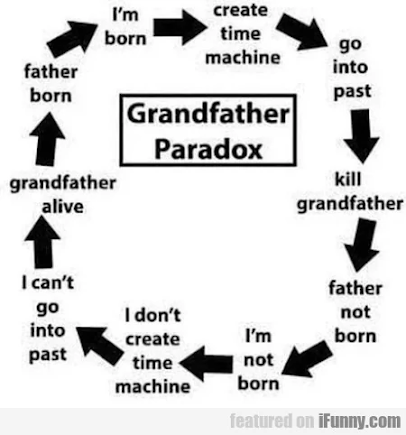
It seems that significant time travel to the future is a theoretical possibility, but it is a one-way ticket. Time travel into the past violates the laws of physics, as we currently know them, and as intimated earlier would create strange and wonderful absurdities. This can be expressed using the 'Grandfather Paradox': consider that you could travel back in time and murder your grandfather before he sired your father. Accordingly, if the father did not exist then neither could the time traveller and therefore you could not have killed your grandfather (refer to diagram). There are those who reconcile the 'Ultimate Paradox' by positing alternative future narratives. So, if you killed your grandfather, there would be a bifurcation of reality where your grandfather continued to live and an alternate reality where his death would result in your nonexistence. Indeed, a select group of philosophers consider taking this thought process even further and consider that every action we undertake in the real world results in the formation of a host of, noninteracting alternative futures. This is not easy to conceptualise and raises many issues that are difficult to resolve from our interpretation of how the Universe works. There could be other explanations, but it has to be acknowledged that perhaps our minds are just not up to tackling this problem. Evolution has moulded our brain to cope with the everyday vicissitudes of life and is not designed to pontificate on the Ultimate Questions of our existence. The late, great Stephen Hawking believed that time travel to the past was an impossibility, and I'm not going to disagree with this towering intellectual giant. This has not stopped speculation on possible ways to return to the past. One consideration promotes the idea of 'Wormholes' in the fabric of the universe, which connect alternative possibilities in both time and space. The problem is we have found no evidence to date to suggest that wormholes exist. There are pundits who consider that entering a black hole would whisk the traveller magically back in time. I'm sure my readers can see the problems with this so-called, solution.

So, as far as we can tell, travel to the future is a possibility, given the right conditions. A return to the past is not so favoured by Natural Law, although I do believe there are equations that predict its possibility. If only we could get hold of 'exotic matter' that doesn't seem to exist. Quite a conundrum.

Anyway, enough of these bollocks, my next post will concern the battle of Crecy.


Thursday, 24 February 2022

Rantus Minimus

                                                White Privilege: Sounds Fair

This is a short and simple rant directed at those who deem that I should be ashamed of my accident of birth.

It appears that being a white man living comfortably in this world is somehow a crime or at least something we should apologise for. Now it is true that most folks in this world live in dire poverty and there are huge manifest injustices endured by vast swathes of people. Is the world a fair place? Manifestly, the world is not a fair place. Your standing, wealth prospects and quality of living is mostly determined by where, when and to whom you are born. Isaac Newton could only have found the comfortable leisure time to be educated and to research the way he did because of his privilege enjoyed by his position in 17th century England. Did he deserve this position? This question makes little sense. Tis better to applaud his good fortune. Not only did he have a prodigious intellect but was also endowed with the leisure time to indulge his good fortune. If he had been born 150 years prior to his birth date, the intellectual milieu of the time would have precluded scientific enquiry. Newton, although a pious man, embraced the new scientific method with gusto. The confluence of these three strands of good fortune enabled greatness and intellectual immortality. Newton, by chance, could have been born a dullard or into a family of stout, but poor yeomen. In such circumstances, scientific advancement, at least to the degree, as shown, would have had to await the occasion of solicitous good fortune in a suitably primed individual, or individuals. I've digressed a tad, but I think I've made my point. It makes no logical or moral sense to castigate an individual thusly blessed.

Continuing with the theme: Another tactic employed by the left is to place the 'guilt of the fathers' upon the heads of the extant. If my ancestor(s) had been involved in the black slave trade, what is that to me? Am I supposed to express extreme contrition at this historical turn of events? Again, the answer is a resounding no. The is no justice in the passing of the supposed sins of the 'grandfathers' to generations now present or still to come. There can be no inherited shame. Although, divine retribution effortlessly transcends the generations, the law of man, is rightly restricted to the miscreant in hand. The justice system of God, of the Old Testament, has never been adopted/adapted by nations, except in the realm of the totalitarian state. God's sense of justice (humour?) is too rich for mortal blood and is to be eschewed.

The left's obsession with 'white guilt' has been ravenously gobbled up by that wretched group, The 'woke'. If this is the cost of being awake, then I'm glad to be the recipient of moral torpor; perchance to dream, the somnolence of the just.      

Thursday, 1 April 2021

Calculus: An Introduction


Is there anything more sublime in nature than the branch of mathematics entitled, calculus? I see the eyes of my readership glaze over and heavy despondent heads sink slowly to heaving breasts. This is the standard reaction when most folk encounter anything mathematical, especially if relating to the perceived notion of, 'Higher Mathematics'. And it is true that calculus can be conceptually complex, if you allow it to be so. But the underlying principles are relatively simple and can be grasped by those who would not consider themselves 'mathematically literate', if they are prepared to put forth a little effort.  

When I first encountered calculus 45 years ago I was mesmerized by its underlying principles and its utility in a host of disparate natural topics. Calculus is founded on the concept of infinity, an abstraction both immeasurably subtle and profound, but also calculus is, without doubt, the most useful mathematical tool we have for solving real life practical problems. It is without hyperbole to state: that much of our technological and scientific achievements would not have been possible without the application of this wondrous mathematical process. 

This post is an introduction to an introduction. This will be a trilogy, of many parts and a series that will unfold as I see fit. Hopefully there will not be an inkling of a 'petit mal'- a grand mal is not even in the realm of a possibility, fingers crossed. My aim is to cover the development of calculus, from its 'inception' 2,500 years ago, through to the conceptual breakthrough independently 'discovered' in the mid 17th century by the two greatest minds that have ever existed, Newton and Leibnitz. I'll deal with subsequent developments and explain how calculus has contributed to numerous scientific and technical innovations. But, do not worry gentle reader, this is not going to be a 'mathematical treatise' resplendent with dense mathematical notation. I will strive to make the enterprise intelligible to the educated lay person with a modicum of intellectual substance. It will require no more than a grasp of elementary mathematics, unless I get very drunk.

This is a germ of a project that has been lurking upon my mind (up on the right and on the second shelf) for quite a while now. I feel it has evolved and progressed to a stage where I can confidently write about the topic in a sequential and coherent manner. To be fair, intellectually important topics, though ultimately complex, are vulnerable to simple breakdown and exposition. This is my goal. 

I'm acutely aware that my blog is highly niche, anyway, especially when it encapsulates my strange, and often, incomprehensible humour (even to the author). Ultimately however, the blog is not an exercise in popularity. For me, it is an exercise in the intellect. Most of my writing is directed to a mythical character called, Flaxen Saxon, and, of course, to the incessant voices in this character's head. If I manage to capture and enslave a few world weary free thinkers along the way tis both an intellectual bonus and a means to engage and commune with like minded folk.  

The second installment in this 'ripping series' will make its presence known, but in a thrice. Arse. 


Saturday, 9 January 2021

The Triumph of Science in the 17th Century


Behold the countenance of two Great men

Following my much awaited previous post: ‘The Life and Times of Sir Thomas More: an Exposition in Sepia’, I thought it profitable to introduce a topic very dear to my heart- the rise of science in the West, during the 17th century.

Our modern world owes much, and has been shaped by the rise of the scientific process in the 17th century. The noted men of science, in the 17th century, are of a different intellectual temperament than their predecessors in several, important and fundamental ways: they no longer demand the asceticism that the ancient and medieval scholars felt was of paramount importance. Previously, a hypothesis had to be ‘beautiful’ or ‘perfect’ according to prevailing notions. Thus, celestial motions had to be perfectly circular as a circle was deemed a perfect figure, according to ancient Greek philosophers. When Kepler, in the early 17th century demonstrated that the planets followed elliptical orbits, contemporary savants were horrified (it was going to get a lot worse); scientists began to understand the importance of astute (and accurate) data gathering as an important prelude to formulating their theories. This was something that many found irksome but necessary for exactitude; the application of the scientific method. The scientific method is simplicity itself but had been sorely neglected, or undervalued, in preceding centuries due to the baleful intellectual influence of the great ancient Greek philosophers who favoured deduction over induction; the break with the philosophies of Plato and Aristotle. The works of these great ancient philosophers were held in great intellectual esteem even though these works had been formulated nearly 2,000 years ago. Men of intellectual quality, in the 17th century, came to realise that Plato and Aristotle were in error on all areas of their ‘scientific’ endeavour.’ They began to realise that the reverence for these ancient Greek scholars had stymied scientific investigation for 2,000 years. This was a shock but also a goad to press on into exciting uncharted scientific territory, anew. There are other salient factors to be considered, however, these are of lesser importance and for brevity they will be omitted (arse, bucket akimbo, arse).

Clearly, the 17th century was an amazingly fertile period for scientific investigation. The word ‘genius’ is banded about with sickeningy frequency in our modern world. Let me be clear: Newton was a genius and so was Tesla- John Lennon, for all his talents, was not. The list of individuals, of true genius, during this period is astonishing and without prior precedent. Let us ponder a few of the greatest scientists in history.

Galileo (1564-1662) kicked off and founded the scientific revolution although it is undoubted that he was influenced by notable and important, earlier savants: Copernicus; Tycho Brahe and Kepler. Galileo is remembered for his work/laws on motion- I don’t have space to write about them here. Galileo was also the first to use the new fangled (not a real word) telescope thingy to scour the heavens and made some very significant discoveries in the field of astronomy. His astronomical observations and his acceptance of the heliocentric model quickly aroused the ire of the Catholic church and poor old Galileo was forced to recant, thus destroying Italian scientific investigation for centuries to come.

Newton (1642-1727) is an extremely interesting topic for discussion. I wrote a a post about him several years ago: find it here. Newton was a genius’s genius, a man of profound intellectual gifts, but he was also exceedingly odd. Although scientific in the conventional sense, he performed a lot of work in the area of Alchemy in the misguided notion that he could turn lead into gold. He was extremely pious, secretive, disputatious, petty, peevish, timid and a life long virgin. For all his genius he would have been a rather dull dinner guest. Newton contributed to the science of optics, light, astronomy (invented the reflecting telescope), formulated the theory of ‘Universal Gravity’, formulated his famous three laws of motion and founded integral calculus. Quite an achievement for one man! In addition, Newton wrote voluminously on religious topics, multi-various (twat).

Gottfried Leibnitz ( 1646-1716), deserves a honourable mention. Although not primarily concerned with science, he made innovative contributions to mathematics, including being the co-founder of differential and integral calculus, with Newton, and created the modern binary system. As an aside, Newton and Leibnitz did not collaborate on the discovery of integral calculus (nuff said). Leibnitz was essentially a philosopher, and his contribution to philosophy was the introduction of Monads, go read, for it makes for an interesting story. I will say no more about Leibnitz as most of his work is outside the remit of this essay, except, that to my mind, he ranks as one of the greatest intellects to have ever lived, together with Newton, Pythagoras and Archimedes (prove me wrong in the comments- if you dare).

There is a litany of great men who made their indelible mark on science, in the 17th century. Here is a list (not exhaustive, nor complete) of the prominent, great men of science, of the 17th century. Each made admirable contributions to science and/or mathematics. Sadly there is no space to consider these men in detail, each require a separate post; keep tuned in: Blaise Pascal; Robert Hooke; Van Leeuwenhoek; Huygens; Halley; de Fermat and etc, and etc.

We are apt to forget the singular and profound importance of the 17th century as a modernising influence on the men of intellectual quality who subsequently changed the world. Most of our modern science is based on, and follows upon 17th discoveries. Perhaps of more importance is the change in the temper/timbre/tempo of mind that occurred. Nothing in the past could compare, and it remains with us today as a thoroughly modern scientific mindset. What a legacy! The importance of this intellectual revolution is worth stressing, especially because of its rapidity in societal terms: in the year of our Lord, 1600, the mind set of educated men was medieval; in 1700, the mind set was thoroughly modern. In England of 1600, witchcraft trials were still in vogue; this would have been unthinkable 99 years later. In addition, human kind had been humbled. No longer was our insular little bubble the centre of the universe. Everything had to be revaluated in terms of our utter insignificance. Church doctrine lagged behind, by degrees. The Catholic church outlook is essentially medieval to this day.


Sunday, 11 October 2020

Life Detected on the Planet Tipton

 A concerned reader writes:

Dearest Flaxen,

I write to express my strident, trenchant, and irrepressible viewpoint. It has not gone unnoticed that your posts of late have become unrepentantly sensible. No longer do we hear the forthright adventures of 'Shagger the Wonder Ferret'; the rollicking peregrinations and antics of George Formby and his grilling ukelele (the lard just rolls away). There is nary a reference to Tipton, errant Japanese snipers, filthy thieving gypo bastards, or Arthur Askey's shenanigans prior to and after losing his legs and cock in a sequential series of increasingly contrived and barely credible accidents. No mention of the hackneyed Prof/Dr/Mr. Mugumbo or of lugless Douglas- he of bereft/sans pinna fame. No incendiary inspired tales of woe or increasing bizarre ruminations of a man teetering precariously on the edge of the abyss that is insanity/inanity. Has your medication finally put paid to the cascade of aberrant thought processes that once flowed unceasingly from your mental vault of derangement?

Dear Concerned Reader,

Thank you for your concern. I confess I detect a degree of weariness in your tone. But despair no more! Due to a pharmacological oversight, I haven't received the correct drug dosage that damps down my more lurid and florid thoughts for quite a while. Therefore, my aberrant synaptic electrical impulses have become unleashed and are no longer burdened or labour under the rein/reign of the brain's executive control. Whoop, whoop.

Yours,

Flaxen  


Breaking news from our science correspondent concerning news of our closet neighbour in the cosdross, Tipton. For today it can be revealed that convincing and intangible evidence has been unearthed that life apparent may exist on Tipton after all. Tipton, of all the boroughs, was considered the least likely to support life due to its complete and utter feculence. Even Netherton, North West, was considered a more likely candidate due to its abundance of Alehouses.

From his observatory, somewhere in Dudley castle, Professor Ipod Mugumbo, opines thusly: “Whilst looking through a lens darkly, I espied Mrs Winifred Plumpbutton, naked through her bedroom window. Afterward, once satiated, I trained my optical organ to the neighbouring borough of Tipton. I put the olfactory sensors on to maximum and was promptly rewarded with the distinct ordure of faggots and mushy peas with a hint of brown ale. Could it be that I had detected the unmistakable scent signature of primitive life? It has long been speculated, by folk with a tenuous grasp on insanity, that Tipton could be the repository for life. Not complex life, or life as we know it but a vile and low form of existence. However, the exhortations have been cast adrift by others who fart loudly in supermarket aisles adjacent to the exotic lard counter."

This startlingly stark observation has nonplussed the scientific community as far away as Merry Hill. A renowned Dudley chemist, Dr. Deepfat Fryer, had this to say: “We must first rule out more mundane and arcane possibilities. For the universe and the West Midland environ is a fickle mistress, full of perfidy and icky poo.”

The next stage in this well-versed farce/arse is to send a probe unto the Tipton miasma to captivate a representative of this putative life form. The probe, code-named, the number 127 bus from Birmingham to Dudley is hoping to arrive next Sunday at approximately 3.30pm depending on the vagaries of the weather, traffic, and last-minute time table alterations. The bus will be driven by Cap'n Jean-Luc Pickarse. He will boldly go into the void where no baldy bastard has gone before. This intrepid escapade is dependant upon the munificence from the prominent Dudley entrepreneur and dedicated wanker, Mr. Earlobe Musky-Bollox. He has promised to invest the full fare from Birmingham to Dudley at the proscribed tariff.

                        Pickarse (Arse) has let himself go a bit

Additional motive force will be provided by the ejection from the rear of the vehicle of several hundred Japanese snipers at frequent and allotted intervals when cresting a hill. Thus thrust will be supplied according to Newton's 4th Law of Motion: Slopes roll down a slope. Dudley, at this time of year, has a glut and surfeit of diminutive, shortsighted, and rhotacism prone adherents to the God/Emporer, Hirohito.

The probe will enter the inhospitable Tipton area after a detour through Smethwick West. Onboard will be the state of the art detection and capture apparatus: some bloke with a net and pointed stick. Prior to entering Tipton, a predictable gaggle of ferrets will be released to reconnoiter the dodgy neighbourhood. The band of ferrets will be led by the inevitable, Shagger, the Wonder Ferret. It will be recalled that Shagger was the first ferret to be placed down Arthur Askey’s (I spank you) voluminous undergarments with hilarious results- I digress.

Dudley, we have a problem

The voyage is not without its incipient dangers. The bus could get lost in the vast reaches of the West Midland environs and end up bereft of purpose somewhere in a canal. Furthermore, a virulent form of life, called the ‘gypo strain’ could inadvertently catch the bus back and be unleashed on an unsuspecting Dudley populous. Imagine hordes of gypos demanding money for lucky heather and wooden pegs. On the upside, everyone has a lucky face.

Renowned Dudley artist (arse) and invert, has produced an impression of what the alien life form could look like. The xenomorph, ‘Stinky Eric’ or aka, the itinerant inebriate, has been rendered in crayon. If captured, Stinky Eric will undergo extreme cauterisation with chlorox and DDT. Afterward, Eric will receive an extensive and prolonged anal probing. This will no doubt celebrate the numerous occasions when Flaxen was callously and extensively anally probed by aliens with uncut fingernails.

                                                   The Xenomorph in his element/milieu
                          

Afterward, the organism aka 'Stinky Eric', will be returned to his natural environment, aka the Tipton Wet Hostel. 


The probe after rear entry


Tuesday, 25 August 2020

ARRSEE.......


How to not be disappointed when things do not go smoothly or right ...

Layfolk are oft of the opinion that scientific research is glamerous, cutting edge and exciting. The truth, of course, is different. Most scientists are not in ground breaking research. Their area of research is often not exciting; not particularly profound and most likely frustrating. In fact, my experience of research is that most of it is repepitive and bloody boring. Equipment often fails and data gathering is haphazard. There is not much glamour in the fact that your lab coat contains more life than the petri dish under examination. For every Einstein and Isaac Newton there are 10⁶ scientists who will never make a 'breakthrough', however minor, and most of their published work will be read by no one.

When my son asked whether he should study science at university, I told him to study IT. On this rare ocassion he actually listened to his dad. Arse.    

9 Real Life Mad Scientists | Real life, Life, Mad science