Thursday, 17 November 2022

Fat Ugly Bloke Wins Beauty Contest


Seems Legit

And so it has come to pass that a biological, 'transgender' man (Brian) has been declared the winner of a US beauty contest. No doubt he will go on to win the title: Miss New Hampshire and subsequently, he/she/it will be crowned Miss United States of America. 

Afterwards, the fat lad opined:

“I am so honoured to be crowned your new Miss Greater Derry 2023, and I am thrilled to show you all what I have up my sleeves. This will be an amazing year”

I'm guessing that he/she/what? will have fat hairy arms up those voluminous sleeves.  

Truly, I have no more to say. 


Saturday, 12 November 2022

Ramblings with a a side of Barbed Wire


In 1867, an American cattle rancher patented, 'Barbed Wire'. A simple invention that revolutionised stock control. A wire structure punctuated every 6 inches by a curly barb- so tantalisingly simple, but effective, in keeping stock from straying from designated areas. It did not take too long before military planners decided to adapt this bucolic device to matters bellicose.

Not only could the wire limit the meandering of the curious ovine, bovine and swine, but its barbs could prevent ingress/egress of the casual interloper. The device was cheap to manufacture, easy and quick to install and performed its designated role with reckless efficiency. It found limited utility in the American Civil War and the Anglo-Boar Wars but it would make its main debut, and prickly presence felt, during the maelstrom of the Great War (1914-1918). After the flurry of military offences at the opening phase of the conflict, combatants quickly realised, that if the war was to be conducted, without further catastrophic casualties (a forlorn hope), a defensive stance would have to be maintained, albeit temporary, until offensives could be undertaken from a position of tactical stability and strength.

At the outbreak of war the concept of adopting a defensive stance was inconceivable and an anaethema to all nations who took part, with the exception of poor Belgium. The accepted and unified dogma dictated that success on the battlefield can only be achieved by aggressive offensive action. Those reliant on static defensive positions would cede the initiative to the aggressor and thusly be doomed to react and be compliant to their enemy's whim and will. And of course, this made perfect sense from an August 1914 perspective. For the French, right from the start, an aggressive attack was considered absolutely essential to carry the day. Sheer moral/morale fortitude was the most respected martial quality. Even the reality of 'modern war', made manifest, would not deter the French offensive spirit. Thus, French trenches always had an air of temporary occupation. The trench system seemed perfunctory to the industrious trench construction of the Germans and, perhaps, the British. Let us not judge the Gauls too harshly. After all, the initial German advance had captured vast swathes of sacred French land. It was a matter of national pride that drove the French to undertake their disastrous offensives of 1914/1915. Let us not forget that the last five months of 1914 accounted for one million French casualties. The flower of French manhood had been squandered in ill-conceived offensives and the French army would never truly recover from the ruinous loss incurred during those scant months of 1914.

By the late months of 1914, it became apparent to even the most hardheaded proponents of offensive action that static defence had become sovereign on the battlefield- the reason(s) are manifold and interrelated. Tis a grand mystery that the power and strength of the defensive position were not fully appreciated by military strategists and thinkers prior to the Great War. All the elements that contributed to the strength of  'defence'  were there to see. In the end, I suspect the various militaries wanted to conduct and enact war according to 'Victorian' social theory, of the time: attack is always bold, heroic, glorious and manly. In contrast, defence is somehow stolid, cowardly and not consistent with the best military virtues (whatever that might mean). Perhaps, the 'Victorian' generals of the Great Conflict could not conceive of war in any other way. They could not conceive how a defensive tactic could eventuate unto a strategic battlefield victory. However, an active, responsive defence, could and would, win battles and wars. As an example consider the battle of Verdun: the Germans battered the Verdun salient from three sides with heavy artillery. The Germans guessed correctly, that the French would defend this patch of land until the last man due to a misplaced sense of honour- a tactic not in keeping with sanity at this stage of the war (February 1916). Equally, senseless, the Germans could not resist throwing in their troops, wave after wave on well-defended positions. They should have stuck to their original plan and their guns that dictated that the artillery would inflict the majority of casualties. But initial success with relatively small numbers of troops goaded the Germans to change their master plan. Never a great idea to change a well-thought-out plan ad hoc. In the end, the Germans suffered as badly as the French and after 6 months of heavy fighting, the French achieved a Pyrrhic victory, of sorts. Also, consider the Kaiserschalkt of March 1918. A close-run thing and the British were but a ferret hair (ferrets have very fine hair/fur) from being pushed to the channel ports. However, the British with French support managed to halt the Germans and begin their own offensive culminating in the armistice of November 1918. In this instance, the attacking Germans not only lost the battle but also lost the war.

As implied, barbed wire was, in many ways, the perfect instrument for the maintenance of a defensive line. Often employed in layers, many yards deep, it was not designed to be impenetrable to infantry; its presence was designed to impede and delay. The attacking infantry would scurry looking for gaps caused by the preceding artillery barrage. More often than not, there was no gap to be had as the shells rarely achieved their purpose. In most instances, the wire was tossed, reformed, rearranged, augmented and reaffirmed in a more effective and deadly impediment to pedestrian progress. Indeed, could there be a more insidious, devilish, humdrum device of war? So banal, so commonplace and so destructive, both physically and psychologically. Men supine, exerting and terrified would have to rely on metal shears, and iron nerves, to carve a path through this dense, oppressive, grasping jumble of wretched steel. And as the men struggled, the machine gun chatter would decimate their ranks, producing scarecrows by the bushel, embraced in a phantasmal, entangled, dance of death.

The coming of the tank in July 1916 gave the Allies the edge to cut the wire. Not only could the rhomboidal behemoths cross the standard German trench, but they could also crush and carve a path for the following infantry. What took artillery days and men hours to effect, the tank did so in mere seconds. It was not the perfect solution, however, as the tracks of the primitive vehicles would become rapidly clogged when traversing thick belts of wire rendering/rending the tank inert, and vulnerable to the ubiquitous drum roll of shell fire.

Enough of the waxing lyrical, Flaxen! True eloquence lies with the men who experienced the horrors and faced the grim reality of war. I have no more to add.

Listen and weep.


Monday, 31 October 2022

Blanket Man

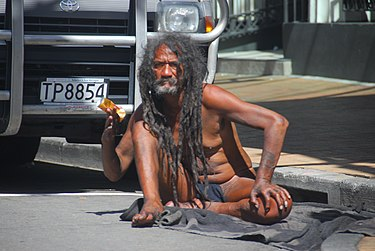
                                                   Blanket Man Waiting for a Waka

 This post has been inspired by one of my regular commenters, who will remain nameless (Doonhammer).

This post, in a way, is a follow on story to my previous post concerning the Iranian hermit. 'Blanket Man' (for it is he) was an exciting fixture in Central Wellington for a decade. He stood out from the other homeless folk congregating in the area due to his erratic behaviour and lifestyle. For instance, he wore nothing but a blanket- hence the monicker. Indeed, his fame spread wide and far and hence he has become immortalised in Wikipedia- go check it out.

Of course, throughout his itinerant existence, he attracted the attention of law enforcement. What can you do to a man who lives outside the law? Predictably, he ended up in 'da nick' for a while and was exposed to the indignity of being assessed by mental health professionals resulting in a residential stint in the Wellington 'Nut House' (Ward 27). Also predictably, once released unto 'civilised' society he took up his usual position and stance/posture in Courtney Place, Central Wellington. 

His convictions were relatively mundane, but legion. Apparently, his police record stretched to 17 pages. Most of his arrests related to drink and drug offences (marijuana). He was more of a nuisance than a criminal menace, although local businesses were none too keen on his shenanigans as he had the woeful habit of cluttering doorways with his filthy presence and depositing sundry rubbish items with random abandon. On one occasion he was convicted of driving a vehicle without a licence. In court, he said he was 'driving' a waka (Maori canoe). His inventive defence cut no sway with the residing magistrate and he was sentenced to 15 years of hard labour in the Wellington gulag (I made that up). Although he was sentenced to community service, on at least one occasion, the fact that he refused to wear shoes or clothes precluded the enactment and fulfilment of his sentence. Obviously, there was little point in administering a fine. 

In 1979 he was charged with drunk driving causing the death of his close friend. It has been suggested that this episode resulted in a 'breakdown' ultimately contributing to his societal withdrawal and vagrancy. Anyway, for whatever reason, he appeared in Wellington City Centre about 2000 and quickly became somewhat of a local celeb, and dare I say it, icon.    

For the most part, he was relatively harmless, although he did have the unsettling habit of exposing his genitals to passing women folk. In spite of his 'stinky demeanour', he managed to attract female attention. Certain slutty elements of Wellington society have been known to satisfy his carnal lusts, after bouts of heavy weekend carousing.   

Blanket Man died in Wellington Hospital, on 15th January 2012, probably of alcohol-related causes. He now resides with his god(s), Tane-mahuta/Ranginui. Apparently, the Maori gods don't adhere to any formal dress code, thus, he will not be castigated/castrated for his brand of sartorial inelegance.  

His name was Ben Hana.

Friday, 28 October 2022

Dirty Dan, the Iranian Man


                                       You can see where he was scratching his head

I am posting on the demise of the world's dirtiest man- a bold claim if you ask me. Anyway, I've decided to put 'pen to paper' in deference to his passing. Here is my previous musing upon this foul but crusty individual. So this fella has been pottering about the Iranian plateau for a goodly 60 years, without a sniff of bodily cleaning products. Eventually, after niffing up the environment and general locale, something awful, the villiage folk decided to take matters unto themselves and subject our  'hero' to thorough bodily cleansing. Not long after however, the shock of being moderately clean was too much and Dan's mortal existence was so sorely tested that he died, mayhap of shock. Although that said, the old bugger was well over 90.

I was so moved by this grim tale of grime, that I have put forth an ode, nay ditty, in commemoration of Dan's filthy existence, sadly snuffed out by an impromptu scrubbing, unwanted and decidedly unwarranted.

A sad tale of woe and dirt, 

As Dan never did have a clean shirt.

No more doth he smoke da shit,

No more doth he pong a bit.

He has gone forth to meet his maker,

No more emitting a noisome vapour.*


* To qualify: this would not apply, of course, if they just left his body to rot under the hot Persian sun. Poetic licence/nonsense. 

Tuesday, 25 October 2022

Fond Musings, Akimbo!

         Behold the Man; Behold the Universe

Before continuing to read this post, I strongly suggest that the reader contemplates, and digests (not literally, of course, that would be just silly) an old post of mine, first penned in 2019, titled: Biocentrism. The topic of biocentrism has been expounded and expanded by a highly renowned scientist and stem cell researcher, Dr Robert Lanza. Essentially, the theory hinges on the concept that without biological entities perceiving the world, the universe and everything, there would be no world/universe/everything. He outlines his approach in two well-written and thought-provoking tomes. His theory enlists current quantum theory and dynamics to support his highly controversial musings. For instance, consider the 'Double Split Experiment'. I will not describe the experiment here, as I have already written about the investigation and its findings in the post on biocentrism. However, I will reiterate that the findings defy rational interpretation and are, frankly, rather unsettling to the cogent mind. However, interestingly, the concept of biocentrism has been put forth as a possible explanation for all this strangeness. When I wrote the 2019 post I intimated that further posts on the topic would follow....... Three years hence, I have decided to pick up the thread and continue where I left off. Consider this post as an introduction to the posts to come.  

In this introduction, it is important to state that I wasn't always the uncompromising and hard-headed rationalist that I have become. In my frivolous youth, I was very open to the possibility of supernatural worlds and occurrences. In part, this was due to an experience I had when I was but 3 years of age. As I distinctly recall to this day, my unsettling and profound experience is as follows: I remember awakening and observing an apparition, close to my bed. The apparition took the form of an old lady, seated. The experience was in vivid colour, clear and distinctly defined. She wore her hair in a grey bun and was clothed in old-fashioned garb, somewhat reminiscent of the early 20th or late 19th centuries. She also wore a pair of half-moon glasses. My ghost appeared very solid and real, to me. There was no animation and I remained transfixed and horrified. The experience, was perhaps, just a few seconds, and then my 'lady' broke up in a mosaic myriad of colours and disappeared. The spell was broken, and thereafter I ran screaming into my parent's room. 

It is possible to rationalise my experience. It is relevant that my vision occurred just as I awoke- remnants of a lucid dream, perhaps? All that said, there remain certain interesting elements to my experience. Thus, 'The Lady of the Council House' has aspects that remain rather intriguing. For instance, the old-fashioned dress and appearance would fit with the age of the house. As I understand the house was built sometime in the latter half of the 19th century. As a 3-year-old, I would not have made the connection at the time. Indeed, it was only when I was much older that I found the whole episode, anachronistic. Spooky, mayhap, although it is conceivable that my unconscious mind altered the experience, over time. But, regardless, the 'scene', taken in its entirety, was evocative of solid reality.

Undoubtedly, my experience influenced my subsequent beliefs and I became prey to various unsubstantiated paranormal phenomena. By my early 20s, I had become immersed in a raft of weird and strange ideologies. This was not to last. Imagine a fresh-faced, young Flaxen attending his first year of  'Big School'. Twas at university that my intellectual life paradigm evolved to things rational and coherent. As my science education progressed I began to grasp that the key to understanding, almost everything about the world, required mastery and appreciation of data acquisition and interpretation through the scientific method. And yet, we have the 'Quantum World' with its own nest of 'reality'. Biocentrism is not the only interpretation that has been put forth. The 'Simulation Hypothesis' has also been considered as a possible explanation for quantum oddity. Predictably, I have written about the simulation hypothesis here, back in 2016. According to the simulation scenario, the strange quantum world is but a glitch in the computer code controlling our 'existence'- Nick Bostrum and Elon Musk are leading exponents.  

I freely admit the bizarre findings attached to all things quantum disturbs my mind, more than I can say- that is why I have to write it down. There is a serious point to be made though. Our ancestors evolved a large brain for a reason. It seems that having an intellect is a positive quality conducive to survival. And here is the rub. We may be smart, but are we smart enough to fully contemplate the overwhelming universe in all its overwhelming and manifest complexity?  We may have to accept, that perhaps, our intellects are simply not attuned to understand and unravel the deep mysteries of our existence. Or perhaps, Biocentrism has the answer(s). Let's take another look at this fascinating concept, at least according to Dr Robert Lanza. Once more into the rabbit hole of DOOM (or enlightenment?).


Tuesday, 18 October 2022

Baghdad Battery

           Battery No More?

I have noticed that my writings, of late, are leaning heavily toward military history. Nothing wrong I hear you say, however, this blog is decidedly eclectic and there are many other areas worthy of appraisal. So, I'm going to redress the balance somewhat by delving into a topic encroaching on science, archaeology and history. 

Thinking ahead, in terms of future posts: I am much taken with quantum mechanics, and theory. Let us be honest, the quantum world is a strange place and is barely understood even by the brilliant theoretical physicists who devote their professional careers to conjuring and taking deep ponderous drafts unto quantum quandaries, various and unlimited. If there was anything that could finally persuade the golden/silver-haired one that a 'supernatural' element encroached upon our ultimate reality, it would, by necessity, be precipitated by a profound contemplation of all things, quantum.  

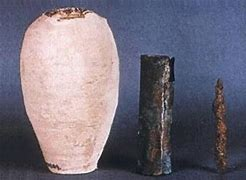
I'm sure most folks have heard of the 'Baghdad Battery'. Exact details concerning the item are sparse and in some instances contradictory. Depending on sources it was either discovered in 1936 or unearthed two years later in the vicinity of Baghdad, Iraq, by the German Archeologist, Wilhelm Konig. Regardless, the item made its way to the local Baghdad Museum and resided in contemplative oblivion, its majesty unsullied and disregarded, until 1940. In 1940, Konig inspected the ancient artefact anew and declared that it belonged to the Parthian period (247 BC-224 AD). However, a subsequent interpretation placed the pot to a later time period, more in keeping with the Sassanid Empire (224 AD- 651 AD). It was during the 1940 examination that the 'battery hypothesis' was advanced.  At this juncture a brief description of the so-called battery will be helpful: the object is a clay pot (see above) 5" in height with an opening of 1.5". The opening had originally been sealed with bitumen. Inside was found an iron rod with evidence of corrosion- not unreasonable considering the artefact's age. In addition, a copper cylinder was found therein and there was evidence of an acidic residue/accretion on the inside of the pot. At face value, the 'battery hypothesis' does not appear to be unreasonable. But let us delve a little more...... 

Firstly, although the copper tube was found to protrude from the jar, through the bitumen plug, the iron rod did not. This does not support the battery hypothesis, as the item as a whole would not be able to sustain an external connection between the two dissimilar metals to facilitate a direct current.  

Secondly, similar pots have been unearthed in the vicinity. Again, the pots contain bimetallic objects. In this scenario, papyrus parchments have been identified, within, often too fragile to gain any further insight. But it seems the ancients have conveniently, and very kindly, left further clues that have enabled archaeologists to postulate a plausible counter hypothesis. Some of the jars contain inscriptions engraved on the inside of the vessel. These inscriptions have survived the ravages of time well enough to be deciphered. It appears that the scribblings relate to invocations and spells against individuals who have fallen foul of the 'inscriptors' (not a real word). Thus it appears the author wishes ill tidings on a neighbour and hopes they receive a good, and mayhap well deserved, spiritual 'kicking'. Sometimes, the most simple and mundane explanation is the most likely. 

Furthermore.......      

In such circumstances, context is king. Do we have evidence of a need for electricity in the time frame under study? To date, there is no evidence, from archaeological digs or contemporary written material, to suggest that the technology, of the time, required electricity. And yes, I am aware of the Dendara 'lightbulb'. It has been put forth that the 'battery' could have been part of an apparatus for gilding silverware. However, not an iota or jot of evidence has been uncovered to support such a hypothesis. Earlier I put forth that 'context was king'; I lied, empirical data is Konig. And now we start to enter, 'woo woo' territory. Of course, fringe, new-age, folk have adopted the battery hypothesis without critical thought and analysis. The artefact has slithered, unhindered and has become carelessly woven into their strange and bizarre word view and landscape and has consequently spawned theories numerous and ponderous. I will not give further credence to factually unsupported utterances. Their 'Arcane Knowledge' is but a click/Gogle away. Drink deep, then discard.   

Sadly, and predictably the artefact disappeared with about 10,000 other items from the National Museum of Iraq shortly after the coalition invasion in 2003. Subsequently, over half of the stolen artefacts were recovered but the current whereabouts of the 'battery' remain unknown. No doubt it will end up in the private collection of a Western billionaire if this is not already the case.      


Sunday, 2 October 2022

On War III


                                                       Samnite Warriors, in Repose

The rise of Rome, from a small town on the seven hills flanking the river Tiber, in central Italy, to the Great Empire it became is a story that has enthralled historians, ancient and modern to their very core. What was unique about this particular city, and its people, that propelled the Romans to rule great swathes of western Europe, and southern Europe, together with the Middle East, the Balkans and north Africa? Rome in 400 BC did not appear particularly special amongst the many warlike peoples of central Italy. But first, there are other matters to contemplate.

Although Greek civilisation was at its zenith, in 400 BC, it had suffered and survived a series of bitterly contested internecine wars, as well as wars against the Persian empire and the Carthaginians. Its greatness, fostered by the fierce independence of the city-state system was ultimately responsible for its downfall. Greece was never a nation and though the Greek cities were bound by language and strong cultural ties, there was never a unity that would allow the Greeks to found and rule over an empire. It is true they would forge leagues and alliances. These leagues formed for defensive and offensive reasons were too fragile to provide true unity- they were always subject to the turbulent flow of Greek politics and changing expediencies. In the end, fractured city-state politics were to be exploited by a semi-barbarous Greek kingdom to the north. Macedonia would bring forth unity and coherence by means of the sword and the skilful manipulation of Greek politics (338 BC).  But it would always be a Macedonian Empire. The Greek cities could never overcome their fierce and innate independence and could never really come to terms with the 'political reality' imposed from without. It took the cohesive genius of Phillip and thereafter, Alexander, to force the Greeks to become partners in the empire to come.

It will always remain a mystery, that after conquering and securing the Persian Empire, Alexander became obsessed with expansion, further east, unto mysterious lands. His army was none too keen and it was their reluctance to continue that would define the eastern limit of his Empire in 324 BC. In hindsight, his persistence was an insane vainglorious adventure not predicated upon sound military or logistical foundations. It seems odd that he never contemplated, turning west, once Persia was conquered. During his exotic bellicose peregrinations, he left one formidable enemy unbloodied and unsullied, 'Westward ho'-, the Carthaginians. 

The Carthaginians hailed originally from the city of Tyre, Phoenecia, and were supposedly founded by an exotic queen/bint with astonishingly acute/astute/cute tailoring skills, sometime in the 9th century BC. Apparently, according to myth and folklore, she was named, Dido. This wayward/seaward seafaring folk made land on the North African shore, in what is now, Tunisia, sometime after teatime. Anyway, it twas an astute colonial possession/progression, and the city they founded was named, rather unimaginatively, 'New City' (Carthage). The relatively civilised Punes (a Greek rendering) soon dominated the barbarous tribes of the hinterland and founded dependent cities along the North African coast. As time went forth, the Carthaginians began to quarrel with the equally land grabbing/grubbing Greeks, especially over possession of the island of Sicily. Eventually, and after much blood-letting, there followed an uneasy truce, leaving the Greeks in possession of the eastern parts, whilst the Carthigininains held the west (265 BC).

And thus, I have set the stage for the entrance of the Romans (stage left). Eventually, the Romans would take over all the Hellenes had built. This was not apparent to Alexander or to his immediate successors, of the time. The Romans were slow and steady on their way to greatness, however, and regardless, their initial succession, albeit sluggish, was inexorable and sure-footed. Certainly, the Carthaginians didn't see them coming.             

By, 290 BC the Romans were well on the way to their conquest of  Italy and were left unmolested by the Greeks until Roman expansion threatened the Greek diaspora in southern Italy. In 282 BC they came into dispute with the Greek city of Tarentum. A notorious Greek king and freebooter, Pyrrhus of Epirus, a nephew of Alexander the Great, decided to intervene on behalf of his Greek cousins. He amassed an army and confronted, and defeated, the Romans at Heraclea (280 BC) in southern Italy. Pyrrhus, like all Greeks, thought of none Greeks as barbarians, Romans included. However, it is said that he was impressed by the Roman army's camp disposition and orderliness. While in hostile territory, Roman soldiers constructed a fortified night camp with a ditch, earthworks and a palisade. On seeing the industrious Romans constructing their camp, Pyrrhus remarked: "funny, they don't act like barbarians". The Macedonian general was able to defeat the Romans once again at the battle of Asculum (279 BC). Both battles were hard fought and costly. It seems that Pyrrhus was not without an ironic sense of humour and exclaimed: "another victory like this one and I will be going home alone" (Pyrrhic Victory). A final battle ensued, in which the Greeks were defeated at Benventium in 275 BC. Pyrrhus had had enough of his Italian adventure and decided that there was more profit to be obtained elsewhere. And so he left his southern Greek allies to their fate. This garrulous Greek offered a final prediction. As he was embarking with his army from Sicily, he declaimed: "what a wonderful wrestling ground we are leaving to the Romans and Carthaginians." It is a great shame I don't have the space to write about this energetic, and generally underrated, Greek soldier/king, in this series of posts. Anyway, he came to an ignominious end after being struck by a roof tile in Argos, in 272 BC.  Worthy of another series, perhaps?           

At this juncture, it will be useful to consider how the Roman army of the time of the Second Punic War (218 BC-202 BC), was organised and armed. For most folk when they think of the Roman army, they imagine a truly professional set-up. In truth, the army only became the professional edifice of modern conception with and after the Marian reforms (107 BC). Prior to the Marian reforms, the Roman army, was very like Greek armies, in that it was a militia formed by citizens who could afford to equip themselves, with arms. The army would be raised for a campaign and disbanded once the hostilities concluded. Originally, the army was armed and fought very much like the Greek hoplite. After a series of wars with a hill people (Samnites) of central Italy (ended 304 BC), the Romans found that their mode of fighting was too inflexible in broken hill country and adapted their equipment and way of fighting accordingly. The Romans were always happy to adopt ideas from their enemies if it suited and ancient writers declare that the Romans copied the Samnite shield (Roman scutum). However, other sources state that the Romans had adopted the scutum at an earlier time. From now on the battle order was more open, and small units of men could operate independently (maniple- 120 men). They also arranged the army into three battle lines: the first line consisted of the youngest class of citizens (hastati); the second line (Principes) contained men in their prime, and the third line was formed of grizzled, battle-hardened veterans (triarii). 

By 272 BC the Romans had conquered most of the Italian peninsula and were about to embark on their first overseas adventure that would set their course to becoming a Great Empire. It was in 264 BC that the Romans decided to meddle in Scillian affairs during which they came into conflict with the Carthaginians. Two glorious wars later, ending in 202 BC, the Romans had control of Sicily, the Mediterranean islands of Sardinia and Corsica, together with most of the Spanish peninsular. Carthaginian power was forever broken and the city was destroyed in 176 BC by the Romans and former Carthaginian territories in north Africa were annexed. 

This will do for now. I consider this post as an introduction to the 'Roman Way of War'; why were the Romans so successful and how have they influenced the Western Way of conducting war up until the modern era? This will of course represent the final post on the 'On War' series unless I decide otherwise.       


`