Monday, 9 January 2023

Morbid Reflections

The Future looks Bleak/Black

We are now truly and firm embedded in the New Year. As I sit here in my study listening to the patter of the rain on the tiles, my mind drifts to contemplate the ultimate question/conundrum- what happens when we die? As I age the question becomes more insistent and intrusive. Recently, my aged mother contracted pneumonia. She lives in a 'Home come Hospital' which best suits her medical issues. The 'Lead Nurse' of the facility warned me that in, her opinion, it was likely that my mother would succumb. Even without a serious illness, she is close to being bedridden. Regardless, the facility provides quality care and tenders to all her needs. Anyway, the nurse provided contact numbers for the local funeral directors and gave me a hug. Three weeks later, the tough old bugger has beaten the infection and is unlikely to die from whatever ailed her.

My mother is not afraid of death. In truth, she relishes and embraces death's icy grip. As a Jehovah's Witness (JW), she has an absolute belief that at some time, in the future known only to Jehovah, she will be bodily resurrected and live upon paradise earth, for eternity. There is no doubt her beliefs give comfort and reassurance. I have to grudgingly admit, I envy my mother's certainty. However, I am well aware of JW teachings, tenets and dogma and I find the whole 'Religious Ediface' laughable, and undoubtedly cultish.

If we are to be strictly honest, thoughts of our ultimate demise become prominent, as we age. I have perpended deeply upon the topic. On reflection, I do not fear death- it would be silly and pointless to do so. That said, I do fear dying in pain and/or the associated loss of dignity. I am a believer in euthanasia, however, this is not a medical option in my adopted country. The wise man knows when he should leave the 'party' and venture unto the great unknown....... Worry not gentle reader, that time is not now.

I have skirted around the topic of Death in many of my posts and expressed my beliefs on what occurs after death. My opinions have subtly evolved over time due to my deep reflections and research. If I'm going to be intellectually honest, when asked the ultimate question, I answer with a firm response: "I do not know". This answer is a sincere reflection of my strict adherence to the 'Empirical Imperative', which underpins the scientific method. Data is required before we can honestly answer any question relating to nature and reality. And herein lies our problem. There is no available information pertaining to what happens after we take our last breath. Some folk would state that there is valid data from 'Near Death' experiences. Let me state the obvious: Near-Death experiences are not data points pertinent to the question. They are merely the expression of a brain deprived of oxygen. Neurophysiologists have convincingly shown that similar episodes can be repeated by stimulating specific areas of the cerebral cortex. Science demands that the subjects under consideration undergo total brain cellular death and thereafter report their findings according to standard medical and scientific protocols. As far as I know, no such data is forthcoming. I await with frenzied anticipation for future developments within this field; it might be a long wait.

Religions, various, have much to say on the topic. I briefly introduced the JW doctrine, sadly my mother believes the whole deal. In a way, my mom is a perfect candidate for the JW religious cult. She is poorly educated and functionally illiterate.

Most religions consider some form of an afterlife where the virtuous are rewarded and the evil-doers punished. During the Middle Ages, Catholic creed was truly wedded to a belief in a literal heaven and hell, and hell was a place of eternal conflagration and torment. These days there has been an official amelioration of the doctrine. In the 13th century a 'Third Domain' was added to the infernal mix of the afterlife. Purgatory (to purge)  became a halfway alternative to everlasting scorching. Purgatory was viewed as a place of 'abode' for those who, in life, committed minor sins. Purgatory was considered a place of cleansing. A temporary residence where its denizens tarried, but for a little while. Presumably, minor miscreants do not receive the whole 'hell experience' and therefore are subject to a light searing, divinely applied.  After a designated interval of 'cleansing', the individual, now free of sin, can happily progress to paradise. 

Judaism, like Christianity, has never had a consistent or unified concept concerning the afterlife. During Jesus's lifetime, different sects and divisions within Judaism held opposing doctrines. Surprisingly the Old Testament has little to say on the matter. From what I can discern, the conservative and strictly adherent Sadducees, considered death as final and consequently dismissed the possibility of 'life after death (surely an oxymoron). Other groups, within Judaism, thought that the afterlife was a rather ephemeral shadowy affair where the soul pottered about in Sheol, slowly fading away. As for modern Judaism, I will say this: Jewish thought is heavily centred upon this life. However, some Jews teach a future bodily resurrection in connection with a coming 'Messianic Age'. The fate of the departed is dependent upon God's judgement. All are judged according to their deeds/misdeeds in life. What transpires after divine justice gets a little hazy and I don't have space here to take into account the options that have been put forth by Jewish savants. 

Both Hinduism and Buddhism believe in reincarnation and reanimation of the soul after death. It is believed that the 'quality' of reincarnation is dependent upon works and actions performed during life. Obviously, this is a very simplistic and under-explained depiction provided by the golden/silver-haired one. The curious should go forth and read anew and become informed and intellectually invigorated!          

This is but a brief survey of religious belief concerning a continuation of consciousness following demise. What is the point of my babblings? Firstly, it seems that all cultures, irrespective of historical context, appear fascinated, absorbed/abhorred by the concept of a form of 'life' following bodily demise. Tis understandable, life is dense, unfathomable and often unfair. What is the point of existence? Why do evil men flourish and wax great, while the just and the righteous suffer indignity and suffering? With a belief in a just deity surely there must be divine redress, if not in this world, then the next. 

The sad truth is that there is no evidence or data to support any of the religious musings concerning the fate of the dead. Science, as practised over the past 400 years, or so, has shown that, as a species, we are nothing particularly special. Mayhap Homo Sapiens are the smartest organism to dominate our fragile planet. All that said, we are animals after all. Animals that share 99% of our genetic make-up with our close relative, the Chimpanzee. Considering all the diverse religions out there, with their diverse views, there appears to be a consensus that humans are special and animated by 'God's spark'. Other animals are lesser breeds and are not so favoured or patronised by the resident deity, of choice. There is no consideration for animals to be suffused with a soul. Will I never bound and prance about with my long-dead ferret, Shagger, in the heavenly realm? The modern enlightened educated man knows the answer. 

Now for a few concluding thoughts. At the start of this 'loquacious post' I declared that according to the rule of the 'Empirical Imperative', I must remain silent as to what happens after we have taken our last breath. No evidence equals no conclusion. However, while I acknowledge this basic tenet, I feel inclined to express an opinion on the available evidence to hand (none). To be honest, the data I put forth belongs to the living organism and not the dead. Unfortunately, dead men tell no tales. 

I have rambled on too long and have broken the sacred '1,000-word rule' when it comes to blogging. May the gods (who/they/them/it - must respect gender fluidity, these days and not presume God's pronoun- after all, he could be a raving pooftah for all I know), give me peace and solace. 

The problem: consciousness is resident within the organ that we acknowledge as the brain. For all our scientific expertise, how awareness and cognisance become manifest is still an unfathomable mystery. Keeping in mind that the property of consciousness is firmly fixed to living neural tissue, and once the brain expires there is a loss of self-awareness, comprehension and thus consciousness. Therefore, I contend that death is equivalent to 'Socrate's gentle sleep'. Expect, but don't experience, oblivion. This is the fate of all cognisant, living organisms, stretching to eternity. Nuff said.            

Tuesday, 3 January 2023

Belated.....

                                           Shagger says: "I'll bite yer nose clean orwf"

 Belated Happy New Year to all my fans. Or as I like to call them: 'Flaxen Acolytes'. Sadly I have not posted as much as I would have liked last month. Real life sometimes intrudes and other matters have taken precedence. I realise that my fan base, scattered wide and far, has been denied my ingeniously crafted posts. Wailing could be heard and on one occasion I distinctly observed gnashing of the molars (sans incisors).

Worry not brethren, I'm girding my loins for a foray into literary cogency, as long as I remember to take my meds. Acolytes of the flaxen-haired one, hark: I can state, with clarity and stout-hearted conviction that the month of January will ring with pertinence and validity/vitality. Posts will fly from my 'pen' and settle with mounting anticipation and erudition upon this blog of wonder. 

Arse

Wednesday, 21 December 2022

Philosophy, but not as we know it

                                                             BOLLUX

Most folks are of the opinion that studying philosophy, as a subject, is a waste of time. And it is true that studying philosophy at university is not always a good idea when comes to career prospects. This specifically applies when the candidate is contemplating a career relating to the subject matter. What I have stated is valid to a certain extent, but higher learning should not be construed as a vehicle for cramming minds with a multitude of information. Higher learning, by its very nature, is not a bucket full of 'rote learning'. Of course, there are facts and concepts that must be mastered. However, it is how we utilise this base knowledge to expand our learning that defines and refines the intellect. It is about developing a critical mindset that not only should be utilised in future employment, but also in other areas of existence. I'm not implying that higher education should be directed at churning out serried rows/ranks of 'Mr Spocks'. And it is insane to suggest that we go through life logically analysing all life's decisions and situations. However, important actions that seriously impact our lives require a measured, rational approach. Back to the point (perhaps): liberal topics, in general, suffer the same opprobrium as ascribed to philosophy. Sadly, although we may be enriched by studying such subjects, bills still need to be paid and the rank lure of economics requires employment commensurate with a perceived lifestyle. A Bohemian lifestyle is not for all. Nuff said.

I've strayed off the path, concerning the title, in an uncharacteristic digression. Just to wrap up: if you are so blessed to attend an institution of higher learning then pick a degree course compatible with the real world. Having an interest in philosophy, psychology or literature is fine. These topics make fine hobbies and diversions. 

The title of this post relates to alternative niche philosophies not well known to folks outside the rarified world of academia. So without further rambling, verbiage and prolixity (and aplomb), let's delve into the dark, dank world of niche philosophy........

The two philosophic schools of thought, Presentism & Externalism, are not particularly well known to lay folk. These two 'spheres of thought' are in direct contrast to each other and each has an interesting take on the concept of time. These two philosophies represent a true idealised dichotomy and to my mind, 'Externalism' is the more interesting of the two. The two topics under consideration, (Externalism, at a later date) and as presented here, are by necessity dealt with in a highly perfunctory manner. The subject matter is not so much drawn in outline, tis more of a fine line, lightly traced, in a pastel shade, with crayon.

Presentism

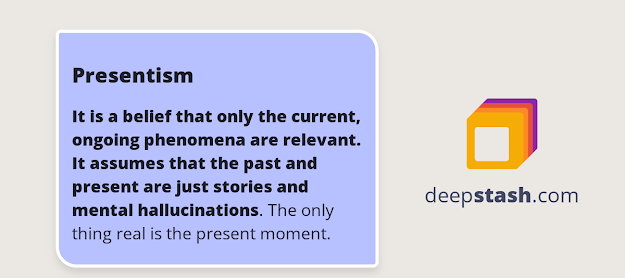
In its simplest form, presentism denies the existence of the past and the future. Only the present is real. Of course, by necessity, the philosophy has to introduce a 'Theory of Time' to bolster its core thesis. Philosophers, both ancient and modern have struggled with 'the concept of time'. 'Time', on the face of it seems a relatively simple notion to vocalise. However, 'Time' is an elusive beast that lurks within the deep recesses of the mind and remains concealed and fleetingly regarded. Indeed, the concept of 'Time' has intrigued and occupied the greatest minds for over two millennia. In truth, the  'the passage of time', as an abstraction, is immensely complex and therein lies a temporal trap for those foolhardy enough to venture there. Then of course along comes Einstein with his unintuitive theories creating a  novel paradigm where time becomes inexplicably linked with space, giving rise to 'Spacetime' Arse.  

Presentism has an association with Eastern philosophical thought, especially Buddhism. On the whole, I'm not a fan of Eastern thought systems. I find them a little too esoteric and unintelligible. For instance, consider the quote from Fyodor Shcherbatskoy, a notable modern Buddhist philosopher: "Everything past is unreal, everything future is unreal, everything imagined, absent, mental... is unreal. Ultimately, real is only the present moment of physical efficiency".  A little too wordy and florid for my taste. 

How are we to imagine past events and plan for the future if such a philosophy is valid? While it is acceptable to consider that future events don't exist because they haven't occurred yet, it seems a strain to extend this reasoning to past events. Past events, by definition, lie somewhere on the time continuum. Events from the past impinge on the present and by a chain of causal links have a direct bearing on the present and will continue to influence a potential putative future. Consider this: Julius Caesar lived just over 2,000 years ago. The evidence for his past existence is overwhelming and from multiple sources. His actions in Western Europe, mainly through the exercise of arms, have had a direct impact on the development of Western culture, language and history. His legacy has left an indelible imprint on our present. Perhaps Presentism is only meant to be understood in a contextual, semantic manner. Thus, the statement, 'Caesar exists' has meaning only if we choose a specific time when he was alive. Caesar existed in the past of 50 BC but it is meaningless to consider that he exists in our present. In a literal sense, he doesn't exist in our present. But it is undeniable that his past existence, in a very tangible sense, has impacted upon the present and the consequences of his deeds will continue to be projected unto the future. I don't see how this philosophic system can counter this criticism. There are more technical and complex objections. If you can find the time, and inclination, consider 'Truth Maker Theory'.   

I was hoping to consider the philosophy of Externalism within this post. However, I have waxed lyrical and prattled on, unfettered. Thusly, my pontifications, on this topic will have to be postponed until a future date. Ain't dat the sad truth.  


Wednesday, 14 December 2022

Poppy

                                                                  Poppy, in Repose


Welcome to Poppy, a new addition to our menagerie of zoological proportions. Poppy, a 5-month Maltese/Shitzu cross was picked up today. She seems to have settled in right away and completes our trio of hounds, including 'Alfie' and 'Little Man'.

As you can see, photography is not a skill that abides in the Flaxen-haired One. 

On a different note: I have a number of incomplete posts that require my urgent ministration and diligence to propel said 'works' unto completeness. I will pursue this aim with due vigour and fortitude and will dedicate the next two weeks, prior to Christmastide, and forgo other activities and thus concentrate my powers unto this noble cause. Arse. 


                                                     More Crap Dogs


Wednesday, 30 November 2022

Evil Simplified


                                                       Dr Mike Licona, in Repose

Dr Mike Licona is a well-respected, tenured professor, in New Testament studies. Due to my interest in theology, I have followed his work and enlivened my day by watching videos where he is involved in vigorous debates with other scholars. Though I often disagree with Dr Licona's theological stance, he is undoubtedly an erudite gentleman with a passion for his work. For context: Dr Licona, besides his academic credentials, is also a committed Christian. He sincerely believes Jesus' resurrection is provable based on sound historical methodology. This places him as an academic outlier. The consensus amongst historians is that the resurrection cannot be understood using the tools available to the historian and the matter is only intelligible in the context of faith.

Today, I came across a short video of Dr Licona addressing an audience of young Christians. A member of the audience asked Dr Licona a question concerning the problem of evil. In essence, it revolves around the following: how can a loving god permit evil. To my mind this problem is one of the most fundamental and important questions that need to be addressed by thoughtful Christians, and, in my opinion, the failure to obtain a satisfactory answer is a serious impediment to a belief in the Christian god. Dr Licona's reply was both illuminating and distressing. Indeed, his answer was rather bizarre and frankly, odd. First off, he effectively states that a belief in a deity is a prerequisite for the basis of objective morality. Does he really believe that atheists can't have a sound grasp of morality? Clearly, you don't have to believe in a supernatural agency to understand that killing and stealing are bad. These moral precepts form the basis for the formation of any civilised society. Surely we are not to follow the morals of  Jahweh of the Old Testament, whereby he indiscriminately destroys whole populations of Caanaites using Joshua and the Israelite armies as an instrument of death. The citizens of Jericho are put to death because god wants the land for his 'Chosen People'. This is hardly a morally edifying tale for us to emulate.

Dr Licona goes on to expand/expound his thesis by using the Holocaust as an example. He argues, that the event happened on the 'cusp of the nuclear age' and the evil of Hitler forced the Allied nations to wage war and defeat him. He goes on to say, that had the Allies intervened later, Hitler may have had the time to develop nuclear weapons. And if that was the case he may well have succeeded in becoming the master of the world. I find the whole argument specious reasoning in the extreme. He treats a very serious theological issue in a simplistic, superficial manner. This is not the answer I would expect from a scholar of his calibre. No doubt the problem of moral evil is an issue that is difficult for serious theologians to tackle. It is a debate that stretches back to the ancient Greeks and subsequently, there have been many sophisticated attempts to explain the disparity between god's supposed 'goodness' and the manifest evil in this world. Dr Licona should know better than present the problem in such a facile way. 

Dr Licona's sincere faith blinds him and I suspect supersedes his academic rigour when it comes to Christian theology. He starts from the premise that the bible elicits literal truth and proceeds to fit the evidence into his own agenda and belief system. This is not how historians work in the modern intellectual arena. Like scientists, they should follow the evidence and then formulate their conclusions accordingly. Often, with limited data to hand, historians, if they are to be intellectually honest, must admit that many of their conclusions are tentative at best. This is not how Dr Licona presents his case and conclusions. His glib and trite response does him no service at all and indeed makes him appear rather shallow, naive and straight-out, silly.  

Am I being overly harsh in my assessment? Listen and weep, and let me know what you think in the comments.


Tuesday, 29 November 2022

Edumucation II


Please note the following YouTube video I came across after posting my previous contribution to this blog. It is relevant and of merit. The world is indeed a crazy place and the modern education system in the West is very much part of that crazy mosaic of insanity. In my adopted country of Nuzzyland, much of what I wrote in my previous prattlings, although I had the US firmly in mind, is applicable. I would counsel prospective students to exercise due care, diligence and great contemplation before entering the hallowed halls of Higher Education. Are you smart as a whip and willing to work hard? Are you interested in the hard sciences or medicine- and have a realistic chance of being accepted at university to study these subjects? Have you considered how your time at college is to be funded and are you happy with the possibility of being burdened with many years of student debt?

Are you interested in attending college to study one of the following: sociology, philosophy, history, English literature or psychology? I ask because you may wish to ruminate very carefully and ponder how your study will help you prosper once the course is complete and how it will further your work prospects. Personally, I'm interested in many topics, including history, however, I would never have gone forth to study the subject at the college level. McDonald's is replete with philosophy graduates.


Friday, 25 November 2022

Edumecation

                                                              None Transferable    
                                                
The power of education. I've approached this topic on my blog before, possibly from a few acute and even obtuse angles. However, tis possible that in this post I have something new to add.

Higher education (post-High School) has been elevated as the ultimate attainment and the necessary requirement for the fulfilment of financial success and stability; an automatic pass unto the 'Middle-Class'. Here everything is rosy and white picket line fences adorn orderly immaculately kept lawns abounding serried ranks of detached homes. Tis/was the American dream after all.  

As a lad, I came to the world of acaedemia rather late. However, once ensconced upon the path of 'enlightenment', I pursued the intellectual route as if Damascus bound. In those halcyon days of the 1970s, my higher educational aspirations were funded by the taxpayer. Not only was my degree paid for but I received a modest stipend. Once graduated I continued my studies and my post-graduate programmes were funded, for the most part, by scholarships. Race forward unto the modern era. The taxpayer no longer funds higher education and the aspiring student (most of them at least) will have to succumb to the pernicious system of serial loans. Their reasoning: once complete, education will lead to high-paying jobs and the money spent will be seen as an investment in future prosperity.

No doubt, the path of Higher Education, in today's bustling economic market and society contributes to the future success of some. Of course, there are those that cannot fail because of familial connections. There is a reason why barristers and doctors have a tendency to run in families. Hunter Biden, anyone? 

It seems that to get any job these days a degree is a prerequisite. For the most part, a degree is not really necessary and the degree itself, in the content taught, is not applicable to the job. This obviously does not apply to vocational positions.  For prospective employers, a degree indicates an air of intellectual respectability and a marker that the candidate has the cognitive wherewithal to be a competent and easy-to-train employee. This argument held sway 40 years ago when perhaps 5% of the population partook in higher education. But in the age of meritoxcracy, 50% of New Zealanders attend University. This statistic is mirrored and reflected throughout the known Western world. What does it mean when higher education becomes commonplace? It has to be a universally good thing, where everyone benefits? Job seekers are more knowledgeable and intellectually prepared for the modern workplace. Employers are gaining employees who are intellectually mature and prepared for entry into the innovative work enviroment. As a counterpoint: if most members of society are obtaining degrees, what does this have to say about the quality of the education being doled out? Back in the day- O those yesteryears when the streets were paved in gold (not dog shit) and a quid could buy a bushel of ferrets (neutered)- those times are no more. Anyway, back to the topic at hand. In the 1960s, for example, higher education was reserved for the intellectual elite and attendance necessitated a degree of mental acumen. It was hard to get in and the degree programme was intellectually demanding. Today, however, all it takes is a participation certificate and a note from mom and the gates of knowledge open, as if by magic, and you enter on a magic carpet made of bank notes.......

Higher education is big business. Governments can no longer fund higher education through taxation and thus it behoves the student to be rich, or more likely, to enter the dark world of debt at the tender age of 18. And then after obtaining the prized degree the newly, intellectually franchised individual, is ready to enter the workforce with a debt of 100k. When making money is the main concern in education you can be assured that the quality of that education is secondary and invariably suffers as a consequence. Let me be frank: a good proportion of students in higher education do not have the innate smarts to complete a legitimate degree course. Sadly, I have seen the effects of the 'money first' principle first-hand. In my previous life, I used to teach and mentor students engaged in a degree course for Lab Scientists. For the most part, the quality of the course and the students encountered was high. This is in keeping with expectations. But even in a topic where intellectual rigour is paramount, I encountered a couple of choice specimens who had wandered far from the ideal. One lad, actually a very nice chap, although not endowed with any intellectual attainment, was particularly exasperating to teach. During the course the students were bidden to undertake a practical research project culminating in a PowerPoint presentation to their peers. I remember the day as if were 15 years ago (it was 15 years ago). The whole presentation was excruciating to watch as it was apparent that the student was struggling with the concepts engendered. I had the task of informing the University Department, by email, that the student would fail this aspect of the course. I received a phone call, within a thrice, informing my good self, that failure was not an option. This particular student was magically transferred to a new mentor for academic consolation.       

You can get a degree in anything these days? Want to study: 'The Patriarchal Oppressor in Western Society', then there is a course for you. My point: many modern degrees are worthless in study and application. There is a reason why entry into the STEM subjects and medicine is hard. You have to show, before admission, that you have the intellectual mettle to complete an intellectually challenging and demanding subject.    

And the upshot: we churn out a host of graduates with unrealistic expectations. Employers are not to be fooled. A degree in gender studies or philosophy is a great foundation for working at Mcdonald's. The student dream of using their degree as a pass into a high-paying profession, is just that, a dream. As it has always been the case, those with talent will do well (all other things being equal), while those cut from lesser cloth will have to tailor their ambitions accordingly. 

Thus far, I have not considered the logical extension of running Universities directly funded by the students. Over the last few decades, there has been an explosion of 'for-profit' institutions. There is no pretence, here. The bottom line is money and the cost of attending is way higher than attending a traditional edifice of education. The only qualification for enrollment is the fee. As for the quality of education, I will say no more here. I have already covered this elsewhere in this esteemed blog. And if you are a really lazy student, there are 'colleges' that will send you a degree certificate without the fuss and dedication of years of study. Just send a cheque and matriculation and graduation are covered by your work experience.

I'm going to be accused of being cynical, world-weary and no doubt, an elitist bastard. Guilty on all counts, M'Lord. I'll leave the post with this last thought (actually it is penultimate): the world is a tough and scary place. Unless you are so fortunate to have been born white, in the West, and rich, you will only rise and succeed by your own ability, grit and mettle. As a viable alternative, for the favoured few,  if you are female, beautiful and blond you could marry into wealth. But for most, there is no real alternative to being smart and hard-working. There is one constant though. The world is still run by the 'True Elites' of this world. And unless the fundamental laws of human nature are about to change, this will always be the case.   

I now come to my last point. How come after my many years of higher study, I still can't bloody spell. Arse.