Monday, 31 October 2022

Blanket Man

                                                   Blanket Man Waiting for a Waka

 This post has been inspired by one of my regular commenters, who will remain nameless (Doonhammer).

This post, in a way, is a follow on story to my previous post concerning the Iranian hermit. 'Blanket Man' (for it is he) was an exciting fixture in Central Wellington for a decade. He stood out from the other homeless folk congregating in the area due to his erratic behaviour and lifestyle. For instance, he wore nothing but a blanket- hence the monicker. Indeed, his fame spread wide and far and hence he has become immortalised in Wikipedia- go check it out.

Of course, throughout his itinerant existence, he attracted the attention of law enforcement. What can you do to a man who lives outside the law? Predictably, he ended up in 'da nick' for a while and was exposed to the indignity of being assessed by mental health professionals resulting in a residential stint in the Wellington 'Nut House' (Ward 27). Also predictably, once released unto 'civilised' society he took up his usual position and stance/posture in Courtney Place, Central Wellington. 

His convictions were relatively mundane, but legion. Apparently, his police record stretched to 17 pages. Most of his arrests related to drink and drug offences (marijuana). He was more of a nuisance than a criminal menace, although local businesses were none too keen on his shenanigans as he had the woeful habit of cluttering doorways with his filthy presence and depositing sundry rubbish items with random abandon. On one occasion he was convicted of driving a vehicle without a licence. In court, he said he was 'driving' a waka (Maori canoe). His inventive defence cut no sway with the residing magistrate and he was sentenced to 15 years of hard labour in the Wellington gulag (I made that up). Although he was sentenced to community service, on at least one occasion, the fact that he refused to wear shoes or clothes precluded the enactment and fulfilment of his sentence. Obviously, there was little point in administering a fine. 

In 1979 he was charged with drunk driving causing the death of his close friend. It has been suggested that this episode resulted in a 'breakdown' ultimately contributing to his societal withdrawal and vagrancy. Anyway, for whatever reason, he appeared in Wellington City Centre about 2000 and quickly became somewhat of a local celeb, and dare I say it, icon.    

For the most part, he was relatively harmless, although he did have the unsettling habit of exposing his genitals to passing women folk. In spite of his 'stinky demeanour', he managed to attract female attention. Certain slutty elements of Wellington society have been known to satisfy his carnal lusts, after bouts of heavy weekend carousing.   

Blanket Man died in Wellington Hospital, on 15th January 2012, probably of alcohol-related causes. He now resides with his god(s), Tane-mahuta/Ranginui. Apparently, the Maori gods don't adhere to any formal dress code, thus, he will not be castigated/castrated for his brand of sartorial inelegance.  

His name was Ben Hana.

Friday, 28 October 2022

Dirty Dan, the Iranian Man


                                       You can see where he was scratching his head

I am posting on the demise of the world's dirtiest man- a bold claim if you ask me. Anyway, I've decided to put 'pen to paper' in deference to his passing. Here is my previous musing upon this foul but crusty individual. So this fella has been pottering about the Iranian plateau for a goodly 60 years, without a sniff of bodily cleaning products. Eventually, after niffing up the environment and general locale, something awful, the villiage folk decided to take matters unto themselves and subject our  'hero' to thorough bodily cleansing. Not long after however, the shock of being moderately clean was too much and Dan's mortal existence was so sorely tested that he died, mayhap of shock. Although that said, the old bugger was well over 90.

I was so moved by this grim tale of grime, that I have put forth an ode, nay ditty, in commemoration of Dan's filthy existence, sadly snuffed out by an impromptu scrubbing, unwanted and decidedly unwarranted.

A sad tale of woe and dirt, 

As Dan never did have a clean shirt.

No more doth he smoke da shit,

No more doth he pong a bit.

He has gone forth to meet his maker,

No more emitting a noisome vapour.*


* To qualify: this would not apply, of course, if they just left his body to rot under the hot Persian sun. Poetic licence/nonsense. 

Tuesday, 25 October 2022

Fond Musings, Akimbo!

         Behold the Man; Behold the Universe

Before continuing to read this post, I strongly suggest that the reader contemplates, and digests (not literally, of course, that would be just silly) an old post of mine, first penned in 2019, titled: Biocentrism. The topic of biocentrism has been expounded and expanded by a highly renowned scientist and stem cell researcher, Dr Robert Lanza. Essentially, the theory hinges on the concept that without biological entities perceiving the world, the universe and everything, there would be no world/universe/everything. He outlines his approach in two well-written and thought-provoking tomes. His theory enlists current quantum theory and dynamics to support his highly controversial musings. For instance, consider the 'Double Split Experiment'. I will not describe the experiment here, as I have already written about the investigation and its findings in the post on biocentrism. However, I will reiterate that the findings defy rational interpretation and are, frankly, rather unsettling to the cogent mind. However, interestingly, the concept of biocentrism has been put forth as a possible explanation for all this strangeness. When I wrote the 2019 post I intimated that further posts on the topic would follow....... Three years hence, I have decided to pick up the thread and continue where I left off. Consider this post as an introduction to the posts to come.  

In this introduction, it is important to state that I wasn't always the uncompromising and hard-headed rationalist that I have become. In my frivolous youth, I was very open to the possibility of supernatural worlds and occurrences. In part, this was due to an experience I had when I was but 3 years of age. As I distinctly recall to this day, my unsettling and profound experience is as follows: I remember awakening and observing an apparition, close to my bed. The apparition took the form of an old lady, seated. The experience was in vivid colour, clear and distinctly defined. She wore her hair in a grey bun and was clothed in old-fashioned garb, somewhat reminiscent of the early 20th or late 19th centuries. She also wore a pair of half-moon glasses. My ghost appeared very solid and real, to me. There was no animation and I remained transfixed and horrified. The experience, was perhaps, just a few seconds, and then my 'lady' broke up in a mosaic myriad of colours and disappeared. The spell was broken, and thereafter I ran screaming into my parent's room. 

It is possible to rationalise my experience. It is relevant that my vision occurred just as I awoke- remnants of a lucid dream, perhaps? All that said, there remain certain interesting elements to my experience. Thus, 'The Lady of the Council House' has aspects that remain rather intriguing. For instance, the old-fashioned dress and appearance would fit with the age of the house. As I understand the house was built sometime in the latter half of the 19th century. As a 3-year-old, I would not have made the connection at the time. Indeed, it was only when I was much older that I found the whole episode, anachronistic. Spooky, mayhap, although it is conceivable that my unconscious mind altered the experience, over time. But, regardless, the 'scene', taken in its entirety, was evocative of solid reality.

Undoubtedly, my experience influenced my subsequent beliefs and I became prey to various unsubstantiated paranormal phenomena. By my early 20s, I had become immersed in a raft of weird and strange ideologies. This was not to last. Imagine a fresh-faced, young Flaxen attending his first year of  'Big School'. Twas at university that my intellectual life paradigm evolved to things rational and coherent. As my science education progressed I began to grasp that the key to understanding, almost everything about the world, required mastery and appreciation of data acquisition and interpretation through the scientific method. And yet, we have the 'Quantum World' with its own nest of 'reality'. Biocentrism is not the only interpretation that has been put forth. The 'Simulation Hypothesis' has also been considered as a possible explanation for quantum oddity. Predictably, I have written about the simulation hypothesis here, back in 2016. According to the simulation scenario, the strange quantum world is but a glitch in the computer code controlling our 'existence'- Nick Bostrum and Elon Musk are leading exponents.  

I freely admit the bizarre findings attached to all things quantum disturbs my mind, more than I can say- that is why I have to write it down. There is a serious point to be made though. Our ancestors evolved a large brain for a reason. It seems that having an intellect is a positive quality conducive to survival. And here is the rub. We may be smart, but are we smart enough to fully contemplate the overwhelming universe in all its overwhelming and manifest complexity?  We may have to accept, that perhaps, our intellects are simply not attuned to understand and unravel the deep mysteries of our existence. Or perhaps, Biocentrism has the answer(s). Let's take another look at this fascinating concept, at least according to Dr Robert Lanza. Once more into the rabbit hole of DOOM (or enlightenment?).


Tuesday, 18 October 2022

Baghdad Battery

           Battery No More?

I have noticed that my writings, of late, are leaning heavily toward military history. Nothing wrong I hear you say, however, this blog is decidedly eclectic and there are many other areas worthy of appraisal. So, I'm going to redress the balance somewhat by delving into a topic encroaching on science, archaeology and history. 

Thinking ahead, in terms of future posts: I am much taken with quantum mechanics, and theory. Let us be honest, the quantum world is a strange place and is barely understood even by the brilliant theoretical physicists who devote their professional careers to conjuring and taking deep ponderous drafts unto quantum quandaries, various and unlimited. If there was anything that could finally persuade the golden/silver-haired one that a 'supernatural' element encroached upon our ultimate reality, it would, by necessity, be precipitated by a profound contemplation of all things, quantum.  

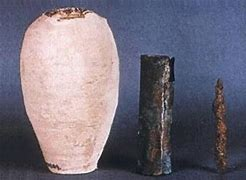
I'm sure most folks have heard of the 'Baghdad Battery'. Exact details concerning the item are sparse and in some instances contradictory. Depending on sources it was either discovered in 1936 or unearthed two years later in the vicinity of Baghdad, Iraq, by the German Archeologist, Wilhelm Konig. Regardless, the item made its way to the local Baghdad Museum and resided in contemplative oblivion, its majesty unsullied and disregarded, until 1940. In 1940, Konig inspected the ancient artefact anew and declared that it belonged to the Parthian period (247 BC-224 AD). However, a subsequent interpretation placed the pot to a later time period, more in keeping with the Sassanid Empire (224 AD- 651 AD). It was during the 1940 examination that the 'battery hypothesis' was advanced.  At this juncture a brief description of the so-called battery will be helpful: the object is a clay pot (see above) 5" in height with an opening of 1.5". The opening had originally been sealed with bitumen. Inside was found an iron rod with evidence of corrosion- not unreasonable considering the artefact's age. In addition, a copper cylinder was found therein and there was evidence of an acidic residue/accretion on the inside of the pot. At face value, the 'battery hypothesis' does not appear to be unreasonable. But let us delve a little more...... 

Firstly, although the copper tube was found to protrude from the jar, through the bitumen plug, the iron rod did not. This does not support the battery hypothesis, as the item as a whole would not be able to sustain an external connection between the two dissimilar metals to facilitate a direct current.  

Secondly, similar pots have been unearthed in the vicinity. Again, the pots contain bimetallic objects. In this scenario, papyrus parchments have been identified, within, often too fragile to gain any further insight. But it seems the ancients have conveniently, and very kindly, left further clues that have enabled archaeologists to postulate a plausible counter hypothesis. Some of the jars contain inscriptions engraved on the inside of the vessel. These inscriptions have survived the ravages of time well enough to be deciphered. It appears that the scribblings relate to invocations and spells against individuals who have fallen foul of the 'inscriptors' (not a real word). Thus it appears the author wishes ill tidings on a neighbour and hopes they receive a good, and mayhap well deserved, spiritual 'kicking'. Sometimes, the most simple and mundane explanation is the most likely. 

Furthermore.......      

In such circumstances, context is king. Do we have evidence of a need for electricity in the time frame under study? To date, there is no evidence, from archaeological digs or contemporary written material, to suggest that the technology, of the time, required electricity. And yes, I am aware of the Dendara 'lightbulb'. It has been put forth that the 'battery' could have been part of an apparatus for gilding silverware. However, not an iota or jot of evidence has been uncovered to support such a hypothesis. Earlier I put forth that 'context was king'; I lied, empirical data is Konig. And now we start to enter, 'woo woo' territory. Of course, fringe, new-age, folk have adopted the battery hypothesis without critical thought and analysis. The artefact has slithered, unhindered and has become carelessly woven into their strange and bizarre word view and landscape and has consequently spawned theories numerous and ponderous. I will not give further credence to factually unsupported utterances. Their 'Arcane Knowledge' is but a click/Gogle away. Drink deep, then discard.   

Sadly, and predictably the artefact disappeared with about 10,000 other items from the National Museum of Iraq shortly after the coalition invasion in 2003. Subsequently, over half of the stolen artefacts were recovered but the current whereabouts of the 'battery' remain unknown. No doubt it will end up in the private collection of a Western billionaire if this is not already the case.      


Sunday, 2 October 2022

On War III


                                                       Samnite Warriors, in Repose

The rise of Rome, from a small town on the seven hills flanking the river Tiber, in central Italy, to the Great Empire it became is a story that has enthralled historians, ancient and modern to their very core. What was unique about this particular city, and its people, that propelled the Romans to rule great swathes of western Europe, and southern Europe, together with the Middle East, the Balkans and north Africa? Rome in 400 BC did not appear particularly special amongst the many warlike peoples of central Italy. But first, there are other matters to contemplate.

Although Greek civilisation was at its zenith, in 400 BC, it had suffered and survived a series of bitterly contested internecine wars, as well as wars against the Persian empire and the Carthaginians. Its greatness, fostered by the fierce independence of the city-state system was ultimately responsible for its downfall. Greece was never a nation and though the Greek cities were bound by language and strong cultural ties, there was never a unity that would allow the Greeks to found and rule over an empire. It is true they would forge leagues and alliances. These leagues formed for defensive and offensive reasons were too fragile to provide true unity- they were always subject to the turbulent flow of Greek politics and changing expediencies. In the end, fractured city-state politics were to be exploited by a semi-barbarous Greek kingdom to the north. Macedonia would bring forth unity and coherence by means of the sword and the skilful manipulation of Greek politics (338 BC).  But it would always be a Macedonian Empire. The Greek cities could never overcome their fierce and innate independence and could never really come to terms with the 'political reality' imposed from without. It took the cohesive genius of Phillip and thereafter, Alexander, to force the Greeks to become partners in the empire to come.

It will always remain a mystery, that after conquering and securing the Persian Empire, Alexander became obsessed with expansion, further east, unto mysterious lands. His army was none too keen and it was their reluctance to continue that would define the eastern limit of his Empire in 324 BC. In hindsight, his persistence was an insane vainglorious adventure not predicated upon sound military or logistical foundations. It seems odd that he never contemplated, turning west, once Persia was conquered. During his exotic bellicose peregrinations, he left one formidable enemy unbloodied and unsullied, 'Westward ho'-, the Carthaginians. 

The Carthaginians hailed originally from the city of Tyre, Phoenecia, and were supposedly founded by an exotic queen/bint with astonishingly acute/astute/cute tailoring skills, sometime in the 9th century BC. Apparently, according to myth and folklore, she was named, Dido. This wayward/seaward seafaring folk made land on the North African shore, in what is now, Tunisia, sometime after teatime. Anyway, it twas an astute colonial possession/progression, and the city they founded was named, rather unimaginatively, 'New City' (Carthage). The relatively civilised Punes (a Greek rendering) soon dominated the barbarous tribes of the hinterland and founded dependent cities along the North African coast. As time went forth, the Carthaginians began to quarrel with the equally land grabbing/grubbing Greeks, especially over possession of the island of Sicily. Eventually, and after much blood-letting, there followed an uneasy truce, leaving the Greeks in possession of the eastern parts, whilst the Carthigininains held the west (265 BC).

And thus, I have set the stage for the entrance of the Romans (stage left). Eventually, the Romans would take over all the Hellenes had built. This was not apparent to Alexander or to his immediate successors, of the time. The Romans were slow and steady on their way to greatness, however, and regardless, their initial succession, albeit sluggish, was inexorable and sure-footed. Certainly, the Carthaginians didn't see them coming.             

By, 290 BC the Romans were well on the way to their conquest of  Italy and were left unmolested by the Greeks until Roman expansion threatened the Greek diaspora in southern Italy. In 282 BC they came into dispute with the Greek city of Tarentum. A notorious Greek king and freebooter, Pyrrhus of Epirus, a nephew of Alexander the Great, decided to intervene on behalf of his Greek cousins. He amassed an army and confronted, and defeated, the Romans at Heraclea (280 BC) in southern Italy. Pyrrhus, like all Greeks, thought of none Greeks as barbarians, Romans included. However, it is said that he was impressed by the Roman army's camp disposition and orderliness. While in hostile territory, Roman soldiers constructed a fortified night camp with a ditch, earthworks and a palisade. On seeing the industrious Romans constructing their camp, Pyrrhus remarked: "funny, they don't act like barbarians". The Macedonian general was able to defeat the Romans once again at the battle of Asculum (279 BC). Both battles were hard fought and costly. It seems that Pyrrhus was not without an ironic sense of humour and exclaimed: "another victory like this one and I will be going home alone" (Pyrrhic Victory). A final battle ensued, in which the Greeks were defeated at Benventium in 275 BC. Pyrrhus had had enough of his Italian adventure and decided that there was more profit to be obtained elsewhere. And so he left his southern Greek allies to their fate. This garrulous Greek offered a final prediction. As he was embarking with his army from Sicily, he declaimed: "what a wonderful wrestling ground we are leaving to the Romans and Carthaginians." It is a great shame I don't have the space to write about this energetic, and generally underrated, Greek soldier/king, in this series of posts. Anyway, he came to an ignominious end after being struck by a roof tile in Argos, in 272 BC.  Worthy of another series, perhaps?           

At this juncture, it will be useful to consider how the Roman army of the time of the Second Punic War (218 BC-202 BC), was organised and armed. For most folk when they think of the Roman army, they imagine a truly professional set-up. In truth, the army only became the professional edifice of modern conception with and after the Marian reforms (107 BC). Prior to the Marian reforms, the Roman army, was very like Greek armies, in that it was a militia formed by citizens who could afford to equip themselves, with arms. The army would be raised for a campaign and disbanded once the hostilities concluded. Originally, the army was armed and fought very much like the Greek hoplite. After a series of wars with a hill people (Samnites) of central Italy (ended 304 BC), the Romans found that their mode of fighting was too inflexible in broken hill country and adapted their equipment and way of fighting accordingly. The Romans were always happy to adopt ideas from their enemies if it suited and ancient writers declare that the Romans copied the Samnite shield (Roman scutum). However, other sources state that the Romans had adopted the scutum at an earlier time. From now on the battle order was more open, and small units of men could operate independently (maniple- 120 men). They also arranged the army into three battle lines: the first line consisted of the youngest class of citizens (hastati); the second line (Principes) contained men in their prime, and the third line was formed of grizzled, battle-hardened veterans (triarii). 

By 272 BC the Romans had conquered most of the Italian peninsula and were about to embark on their first overseas adventure that would set their course to becoming a Great Empire. It was in 264 BC that the Romans decided to meddle in Scillian affairs during which they came into conflict with the Carthaginians. Two glorious wars later, ending in 202 BC, the Romans had control of Sicily, the Mediterranean islands of Sardinia and Corsica, together with most of the Spanish peninsular. Carthaginian power was forever broken and the city was destroyed in 176 BC by the Romans and former Carthaginian territories in north Africa were annexed. 

This will do for now. I consider this post as an introduction to the 'Roman Way of War'; why were the Romans so successful and how have they influenced the Western Way of conducting war up until the modern era? This will of course represent the final post on the 'On War' series unless I decide otherwise.       


`       

Monday, 26 September 2022

Socrates Has the Best Answer

     Jewish Heaven- please do not  adjust your set

I'm just putting the final touches on my third post in the much-vaunted series, 'On War'. To break up the bellicose monotony I felt moved to intersperse a post concerning the oft-misunderstood topic of ancient Judaic and early Christian concepts relating to what happens after we die.

Humankind is obsessed with death and the question of what happens after we die. Tis the final great mystery. To be fair, there is no intellectually satisfying answer to this question. If we are, to be honest, we must throw our hands up in the air and state: we don't know. This has not stopped speculation on the matter. Religions, numerous, and the Christian religion, in particular, have an unequivocal answer- yes there is an afterlife, although when pressed, religious leaders are unable to provide specifics, except the Jehovah's Witnesses- they are very specific; they are always specific. Tis to be noted that many Christian sects denounce the JWs and do not consider the adherents as Christians. And likewise, the JWs are more than happy to return the compliment. For simplicity, and for the sake of consistency, I'm happy to exclude Jehovah's Witnesses from the Christian fold and covenant.

Returning to the beliefs of 'Real Christians'. What is the Christian concept of heaven; where is heaven to be placed and what do we actually do there as we ride out an eternity? If we are to accept that Christianity is founded upon Judaism, then we would do well to examine what Judaism teaches about the afterlife, in the centuries before Jesus' birth, and subsequent to his demise (arbitrary divisions). Also, what do modern Jewish scholars think happens after we draw our final breath?

For Jesus' historical antecedents, the above question is easy to answer: there was no expectation of an afterlife. The Torah (first five books of the old testament), if you dare to read, have nought to say upon this matter. All that can be inferred is that your corporeal existence is your Lot. No heaven or 'Great Mystery' was to be asked or answered. Perhaps it was why the ancient Jews (and modern Jews) placed, and place, such a great emphasis on doing good and doing no harm during, this life. This is the core essence of Judaism to this day, the so-called: Golden Rule. It could be argued that any further admonishments/ embellishments are just/Just commentary- go read. This universal view began to change, in some Jewish circles, at least, during the 6th BC century. Thoughtful Jews began to ask: ''how come the righteous in this life suffer, while the rich and the wicked prosper? Surely this is blatantly unfair?'' This line of thought may have become popular at about the time Jerusalem was sacked by the Babylonians and many Jewish families were marched off into exile. 

While it is true that there is virtually no mention of an afterlife in the written Torah, the oral Torah speaks volumes. I will not go into why the oral Torah became into being, how it was promulgated and why it was thought necessary after 70 AD to put forth into writing.  In essence, the written oral tradition (surely an oxymoron) is but a commentary on the Torah developed by Jewish scholars over many centuries. Anyway, although it is difficult to extract a coherent and consistent 'after-life tradition', certain elements are worthy of comment. When God made Adam, he did so by breathing 'divine breath' into inanimate mud to create life. Interestingly, the Hebrew word for spirit and breath are the same (ruah). And expanding on this theme, we can see how the ancient Jews could conceive of death as a time when the last breath (spirit) leaves the body. Aspects of Judaism began to, as I understand it, perceive a reawakening of life when the physical body and the spirit (breath) come back together. This will occur en masse on a future judgement day (End of Times). Living corpses, deemed righteous and worthy will reside with God, forever. The naughty folk will be destroyed. To be honest, this view is not universal. By Jesus' time the Pharisees believed something like this, although the conservative Sadducees appear to have abided by the teachings of their ancestors, in that, there was no existence after death. Both the body and the soul would cease to exist. From the gospels, it is reasonable to infer that Jesus' pontifications on the afterlife were in tune with what the Pharisees expected. In this regard, consider the parable of the 'Sheep & Goats' (Mathew's Gospel). This is the view of most modern, critical bible scholars on how Jesus viewed the afterlife. That said, not all serious scholars agree. Jesus' teachings are not always internally consistent throughout the Gospels. This likely has more to do with how the unknown gospellers interpreted Jesus' teachings, within their own doctrinal context and prejudices, rather than due to the original teachings of the Nazarene.  

Modern lay Jews, if they have an opinion on the matter, are likely to stick to the Pharisee's interpretation. This also seems to be the majority viewpoint amongst Rabbis. Judaism has always been a religion of 'this life', as already mentioned. Modern Judaism reflects this ancient tradition. Furthermore, Jews are becoming increasingly secular in their thought. There are, however, ultra-conservative sects that remain strict in their observance of the Law and the tenets of Judaism. From my observations, a significant proportion of Jews are 'unbelievers' however, they continue to practise Jewish rituals, to a lesser or greater extent, as a consequence of strong cultural associations and identity. In addition, there is a minority perspective that speculates that even the 'ungodly' will eventually be saved after a relatively brief period in some form of purgatory. This is akin to Catholic doctrine. Though, as I understand it, purgatory, in the Catholic tradition, is a place where 'the good/godly' go to be purged (tis in the name, after all ) of their sins before being allowed into heaven- this is not an option for the naughty- straight to the hot place, for eternity, for them.  The Jewish doctrine of purgatory seems a tad more humane than the Catholic version. And let's be honest, with our knowledge of human nature, to the fore, a more sensible and ultimately practical, proposition. 

And finally, I'll consider the early Christian stance and thoughts on the 'thereafter'. I think it is fair to state, that the earliest Christians (they were born Jews, after all), adopted the mainstream Jewish doctrine, of the time, with regard to the possibility of an existence after death. Christianity's future (and virtue) lay, not with the Jews, but with the Greek-speaking gentiles of the Roman Empire. Gentile converts immersed in Greek concepts of life and death undoubtedly had different ideas from their Jewish contemporaries. And these ideas and concepts were well established amongst the ancient Greeks and differed significantly from Jewish notions. It is fair to state, that the Greeks considered their own teachings, culture and philosophy vastly superior to those of different cultures, including the Jews. Therefore, Greek-speaking converts added their own Greek philosophic concepts to Christianity, and this included their own pagan Greek ideas of  'life after death'. And it is these concepts that would form the basis of Catholic philosophy, eventually- Jewish doctrines were to be discarded, willy-nilly. 

Tis enough for one post. I will go into more depth on the topic of 'Early Christian Thought on the Afterlife' in a second post. Also, I would like to look at how the concepts of Christian Heaven and Hell developed over the centuries culminating in the dominant views of the various, major Christian denominations. This may develop into another enthralling series.      

Saturday, 24 September 2022

Promenading About Town


Needs a Nostrum, Methinks

Yesterday, I decided to wander around my local town to engage in a modicum of focused shopping. Mrs F did not accompany me on this occasion. Sadly, she has had a series of surgeries on her right foot and is thus convalescing at home with a strict injunction, from the banebrake, not to place weight upon her macerated appendage. Consequently, shopping in the town is forbidden. And so, I'm allowed to shop unfettered. Although I would not wish enforced immobility on my good wife, the opportunity to engage in light, untethered shopping is a boon that needs to be clasped/grasped between two plastic shopping bags (if you can find 'em), with alacrity.

 When it comes to shopping, Mrs F is not of this world. To be honest, I regard shopping as a necessary chore, and as such, should be undertaken as efficiently and quickly as possible. Mrs F belongs to a different school of philosophy where shopping is a studied and divine form of recreation. She is quite happy to spend all day shopping and to return to the garth with nowt but corns. In practice, this means I avoid accompanying Mrs F on any of her 'shopping extravaganzas', with due gusto. I am not alone in my assessment of my wife's shopping prowess. In fact, our son and daughter are also none too keen to engage in said activity with the woman that gave them life. Moving forward.......

Anyway, I was between shops when I espied a gaggle of folk on the corner of Ferret Street and Ferret Boulevard. As I'm of a curious disposition I was drawn unto the congregation and peregrinated thereoff/ forthwith. To my surprise, and on further inspection, the commotion concentrated upon a proselyting duo of Jehovah's Witnesses (henceforth known as, JW x 2). Why do they always come in twos- if not pairs?  If I had been accompanied by Mrs F, I would be obliged to look the other way and continue without gainful and fruitful engagement. I would get the: 'don't you fucking dare/stare'. As I was without restraint/constraint either physical or ethereal, I decided to ask the sweet smiling, middle-aged lady for spiritual enlightenment. After a few probing enquiries, it became quite apparent that I was not dealing with the intellectual elite of the organisation. My opinion became fully cemented once she asked from where I once hailed. I replied that I was birthed in the township of  Dudley in the faraway kingdom of England.  Immediately upon my exclamation, she followed up with: "Then you must have heard of Kenny Smith, he's from England". After a brief pause/hiatus, I replied, accordingly: "Could this be the Kenny Smith of 24 Mons Road, Kate's Hill, Dudley. She responded: "No, he was from Wigan". Twas at this time I decided to terminate the conversation, go home, and drink copious amounts of fine ale. This was of course rather unusual as the majority of JW x 2 I have conversed with in the past have buggered off, of their own volition, admittedly after I had been confronted upon my own doorstep. For reasons, that will always remain inexplicable to me, JW x 2 are none too keen to prolong our dialogue.  But on this occasion, I made an excuse, stating that the 'Mega Supa Big Woppa Do Da Store' was having a sale on expired and fire damaged  Arthur Askey Memorabelia- I thank you. I wonder if Kenny Smith reads my blog?